
FTAsiaFinance Stock Analysis: Trends & Outlook 2026
Digital FTAsiaFinance Stock has moved from a niche corner of the technology world into one of the most closely watched sectors in global markets. Investors, analysts, and everyday savers now track fintech companies with the same intensity once reserved for traditional banks and blue-chip industrials.
Understanding how these companies perform, what drives their stock movements, and where the sector is heading has become essential knowledge for anyone with a stake in modern finance.
This article breaks down the key forces shaping fintech stock performance today, the risks investors should weigh, and the long-term trends likely to define the next phase of digital finance.
The Rise of Digital Finance as an Investment Category
A decade ago, financial technology was mostly associated with mobile payment apps and basic online banking. FTAsiaFinance Stock Today, it spans automated trading systems, blockchain-based settlement networks.
AI-driven forecasting tools, cross-border payment infrastructure, and fully digital investment platforms. This expansion has turned fintech into a distinct and closely monitored investment category rather than a side note within the broader technology sector.
The shift didn’t happen overnight. Traditional financial institutions were often slow to modernize, weighed down by legacy systems, layers of regulation, and cautious internal cultures. Digital-first companies moved into that gap, offering faster onboarding, lower fees, and more transparent user experiences.
As adoption grew, so did investor interest, and stock performance in this space began reflecting broader shifts in how people manage money, invest, and transact across borders.
Understanding fintech stock market trends now requires looking beyond a single company’s earnings report. FTAsiaFinance Stock It means paying attention to consumer behavior, regulatory developments, technological breakthroughs, and macroeconomic conditions all at once.
Also Read: PedroVazPaulo Business Consultant: Smart Strategies for 2026
Historical Performance Patterns in Fintech Stocks
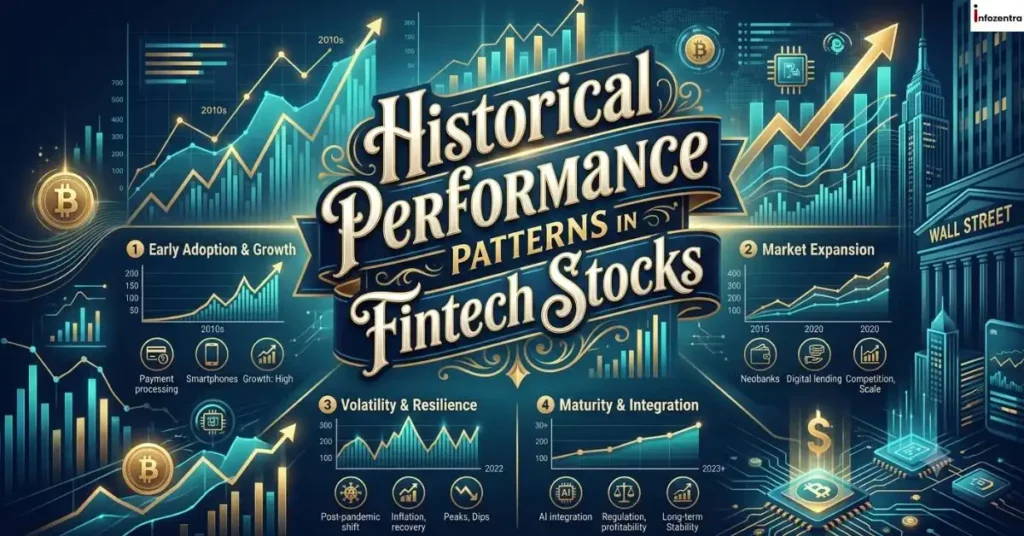
Fintech stocks, as a category, tend to follow a recognizable arc. In their early growth phase, they often experience sharp volatility. New companies are still proving their business models, competing for market share, and adjusting to regulatory frameworks that weren’t originally designed with digital finance in mind. FTAsiaFinance Stock This period can produce dramatic price swings as investors try to separate genuine innovation from short-lived hype.
As companies mature, stabilize their revenue streams, and demonstrate consistent user growth, performance tends to smooth out. Stocks that survive the early volatility phase often settle into steadier, more predictable trading patterns, punctuated by periods of acceleration tied to product launches, strategic partnerships, or expansion into new markets.
It’s also common to see corrections that have little to do with a company’s internal performance. Broader economic downturns, interest rate changes, or shifts in investor risk appetite can pull an entire sector down together, even when individual companies remain fundamentally sound.
Recognizing this distinction — between company-specific weakness and sector-wide correction — is one of the more valuable skills an investor can develop when following fintech stock market trends.
Also Read: Advertising Feedbuzzard: Unlock Real ROI in 2026
Key Factors Driving Fintech Stock Movements
Adoption Rates and Consumer Behavior
The single biggest driver of long-term value in digital finance is adoption. As more consumers and businesses shift away from cash and traditional FTAsiaFinance Stock banking toward digital wallets, online lending, and automated investment tools, companies positioned to serve that demand tend to see stronger revenue growth.
Rising adoption rates are often one of the clearest early signals of where market trend momentum is heading.
Technological Advancement
Innovation cycles move quickly in this sector. FTAsiaFinance Stock Companies investing in artificial intelligence for fraud detection, predictive analytics for investment recommendations, or blockchain infrastructure for faster settlement times often gain a competitive edge.
When a company demonstrates real technological differentiation — not just marketing language — investors typically respond with renewed confidence, which can show up directly in stock performance.
Regulatory Environment
Few sectors are as sensitive to policy shifts as digital finance. New data privacy laws, updated licensing requirements, cross-border transaction rules, and evolving cybersecurity standards can all move markets quickly.
A favorable regulatory environment tends to support growth and stability, while sudden regulatory tightening can create short-term uncertainty, even for companies with strong underlying fundamentals.
Investors following business trend patterns in fintech need to treat regulatory news as a core part of their research, not a side consideration. FTAsiaFinance Stock A single policy announcement in a major market can shift sentiment across an entire sector within days.
Macroeconomic Conditions
Interest rates, inflation, currency strength, and overall consumer spending power all filter down into fintech performance. During periods of economic stability, digital financial activity tends to rise, benefiting companies across the sector.
During downturns or periods of heightened uncertainty, discretionary financial activity often slows, which can weigh on growth-stage companies that haven’t yet built deep, defensible revenue bases.
Investor Sentiment and Market Psychology
Fintech, more than many other sectors, is shaped by forward-looking expectations rather than current earnings alone. FTAsiaFinance Stock Positive analyst coverage, strong quarterly updates, or a well-received product launch can build momentum quickly.
The flip side is also true — sentiment can shift on news that has little direct connection to a company’s actual fundamentals, simply because investors treat the sector as interconnected.
What Analysts Are Watching
Financial analysts covering the digital finance space tend to focus on a consistent set of indicators when evaluating long-term potential.
Growth trajectory is often the starting point. Analysts look at whether user bases, transaction volumes, and revenue are expanding at a sustainable pace, rather than through unsustainable spending on customer acquisition.
Competitive positioning matters just as much. In a crowded field of established banks, technology giants, and emerging startups, companies need a clear differentiator — whether that’s proprietary technology, a unique market niche, or superior user experience — to maintain pricing power and customer loyalty.
Financial discipline is another key marker. Rapid growth is appealing, but analysts increasingly reward companies that pair expansion with controlled spending and a credible path to profitability, rather than growth funded entirely by external capital.
Market alignment rounds out the picture. Companies whose strategies align with long-term structural trends — such as the global shift toward cashless transactions, automated investing, and cross-border financial integration — tend to be viewed as better positioned for sustained performance over multi-year horizons.
Risk Factors Every Investor Should Understand

No discussion of fintech stock performance is complete without addressing risk. This is a dynamic, fast-moving sector, and volatility is part of the territory.
Market volatility is often more pronounced here than in more established sectors. New product launches, competitive disruptions, or even rumors about upcoming technology can trigger significant price swings in a short period.
Regulatory uncertainty remains one of the more persistent risks. Because digital finance often outpaces existing regulatory frameworks, companies can face sudden compliance requirements, fines, or operational restrictions that weren’t anticipated when the business model was first built.
Intense competition is another structural challenge. The barriers to entry in some fintech niches are lower than in traditional banking, which means new competitors can emerge quickly, applying pricing pressure and fragmenting market share.
Technology dependence cuts both ways. The same technological innovation that drives growth also introduces risk — system outages, cybersecurity breaches, or failed product rollouts can damage user trust and, by extension, investor confidence, sometimes quickly and severely.
Economic sensitivity is worth remembering as well. Even fundamentally strong companies can see temporary declines during broader economic slowdowns, simply because digital financial activity tends to contract along with overall consumer and business spending.
Understanding these risks doesn’t mean avoiding the sector — it means approaching it with realistic expectations and a diversified strategy rather than concentrated bets on hype alone.
Long-Term Trends Shaping the Future of Fintech Stocks
Continued Global Adoption
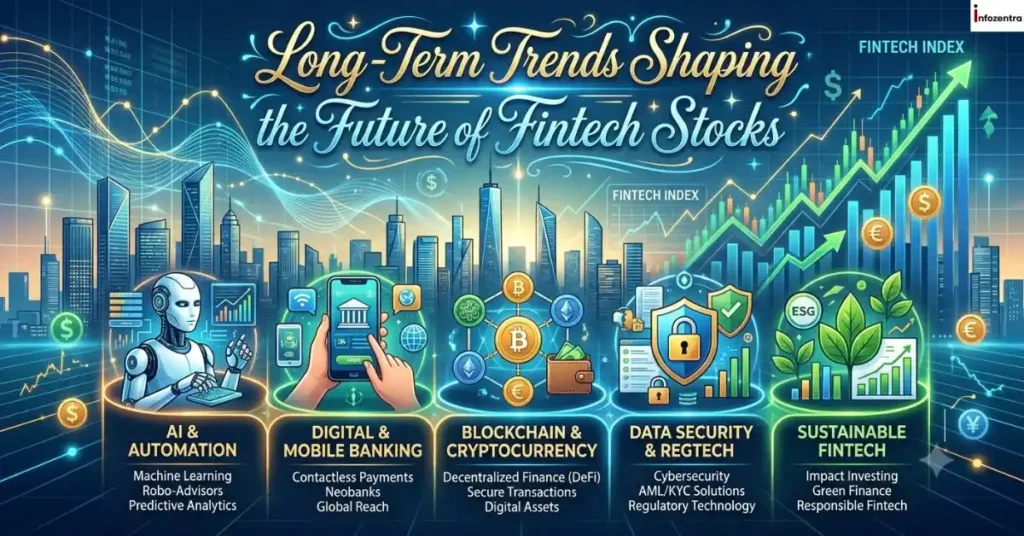
The shift toward digital-first financial services shows no sign of slowing. As internet access expands in emerging markets and younger generations enter the workforce with digital-native financial habits, the addressable market for fintech companies continues to grow. This structural tailwind supports long-term optimism for the sector, even amid short-term volatility.
Deeper Integration of Artificial Intelligence
AI is moving from a marketing buzzword to a genuine operational advantage. Companies using machine learning for credit risk assessment, fraud prevention, personalized financial recommendations, and predictive market analysis are setting new standards for efficiency and accuracy. Over time, this is likely to widen the gap between companies that adopt these tools effectively and those that lag behind.
Blockchain and Distributed Ledger Technology
While early hype around blockchain has cooled into more practical applications, the underlying technology continues to find real use cases — particularly in cross-border settlement, transaction verification, and reducing friction in international payments.
Companies that integrate this technology thoughtfully, rather than as a marketing gimmick, are likely to see tangible operational benefits.
Expansion into New Geographic Markets
Global expansion remains one of the clearest growth levers available to fintech companies. Entering new regions — particularly those with large unbanked or underbanked populations — offers significant upside, provided companies can navigate local regulatory requirements and build trust with new user bases.
Supportive Policy Environments
Many governments are actively encouraging digital economic growth, recognizing that financial technology can improve access to services, increase transparency, and support broader economic development.
Where policy environments remain supportive, companies in this space are likely to find more room to innovate and expand.
A Shift Toward Sustainable, Long-Term Value
Investor expectations are evolving. Where early fintech investment was often driven by rapid growth narratives alone, there’s a clear shift toward valuing sustainable business models — companies that balance innovation with financial discipline, clear paths to profitability, and responsible governance. Environmental, social, and governance (ESG) considerations are also playing a growing role in how institutional investors evaluate this sector.
Practical Takeaways for Investors
For those following market trends in digital finance, a few principles consistently prove useful:
- Separate hype from fundamentals. Strong headlines don’t always translate to strong underlying business performance. Look past the narrative to actual growth, revenue, and competitive positioning.
- Watch regulatory developments closely. Policy changes can move this sector faster than almost any other single factor.
- Diversify across the sector rather than concentrating risk. Given the volatility inherent in fast-growing technology-driven companies, spreading exposure can help manage downside risk.
- Think in multi-year horizons. Short-term price swings are common, but the structural trends driving digital finance adoption are long-term in nature.
- Stay informed on technological differentiation. Companies that build genuine, defensible technological advantages tend to outperform those competing primarily on price or marketing.
How Fintech Stocks Compare to Traditional Financial Institutions
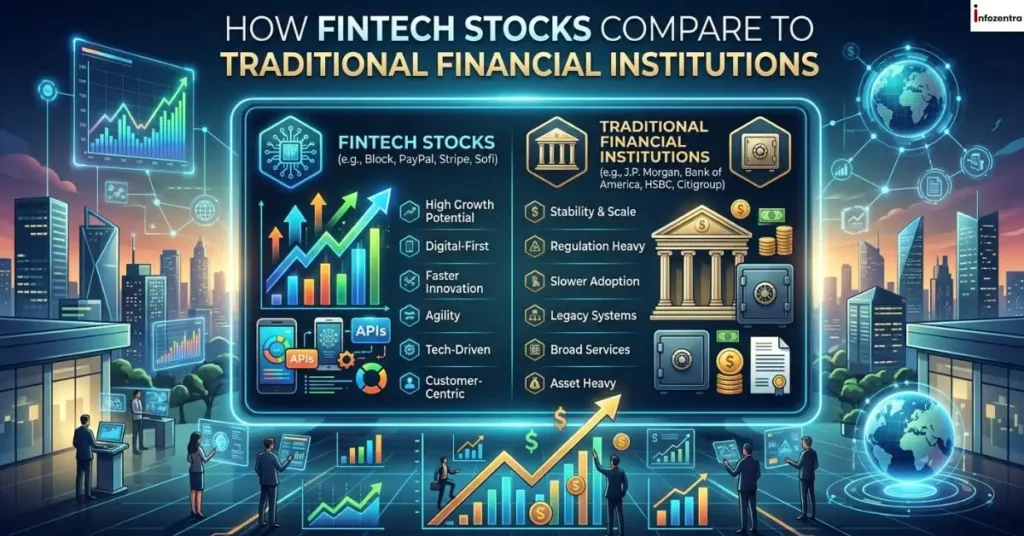
One question investors frequently ask is how fintech companies stack up against long-established banks and financial institutions when it comes to stock performance. The comparison isn’t always straightforward, because the two categories often operate under different growth assumptions and risk profiles.
Traditional financial institutions tend to offer more predictable, slower-moving performance. They generally carry decades of operating history, established regulatory relationships, and diversified revenue streams spanning lending, deposits, wealth management, and insurance.
Their stock prices often move in tighter ranges, reacting primarily to interest rate changes, credit conditions, and broad economic cycles.
Digital finance companies, by contrast, are frequently still in growth or expansion phases. Their valuations often price in future potential rather than just current earnings, which is part of why their stocks can be more volatile in both directions.
A strong product launch or user growth report can send shares sharply higher, while a disappointing update or increased competition can trigger an equally sharp pullback.
This doesn’t necessarily make one category superior to the other — it simply means they serve different roles in an investment portfolio. Traditional financial stocks often provide stability and steady income through dividends, while fintech stocks can offer higher growth potential paired with higher risk.
Many experienced investors choose to hold a blend of both, using fintech exposure to capture upside from digital transformation while relying on more established financial institutions for portfolio stability.
It’s also worth noting that the line between these two categories is increasingly blurred. Many traditional banks have invested heavily in their own digital transformation, launching AI-powered tools, mobile-first banking experiences, and blockchain pilot programs.
As this convergence continues, the distinction between “fintech stock” and “traditional financial stock” may become less meaningful over time, with performance increasingly tied to how effectively any given institution executes on technology and customer experience rather than which category it originally belonged to.
The Role of Data and Analytics in Modern Investment Decisions
One of the defining characteristics of the current financial landscape is the sheer volume of data available to investors. Where past generations relied heavily on quarterly reports and analyst commentary, today’s investors have access to real-time transaction data, sentiment analysis tools, alternative data sources, and AI-powered forecasting models.
This shift has changed how market trends are identified and interpreted. Instead of waiting for official earnings releases, sophisticated investors and institutions now track leading indicators — app download numbers, transaction volume trends, website traffic, and social sentiment — to anticipate performance before it shows up in official filings.
This has made markets more efficient in some respects, but it has also increased the speed at which sentiment can shift, contributing to some of the volatility discussed earlier in this article.
For individual investors, this data-rich environment offers both opportunity and challenge. On one hand, more information is available than ever before, allowing for more informed decision-making.
On the other hand, filtering signal from noise has become increasingly difficult, particularly when so much financial commentary online is generated quickly and without rigorous fact-checking.
Developing a disciplined process for evaluating sources, cross-referencing data, and distinguishing between short-term sentiment and long-term fundamentals has become an essential skill for anyone actively following stock performance in this sector.
Companies that build strong internal data and analytics capabilities also tend to gain a competitive advantage. The ability to accurately assess credit risk, detect fraudulent activity in real time, personalize financial products for individual users, and forecast demand trends all depend on high-quality data infrastructure.
Investors evaluating a company’s long-term potential increasingly look at these capabilities as a core part of the investment thesis, alongside more traditional financial metrics.
Building a Balanced Approach to Fintech Investing
Given the combination of strong long-term growth potential and elevated short-term volatility, building a balanced approach is particularly important for anyone considering exposure to this sector.
Start with clear time horizons. Short-term traders and long-term investors often need fundamentally different strategies. Someone looking to capitalize on short-term price movements needs to pay close attention to news cycles, technical indicators, and near-term catalysts.
A long-term investor, by contrast, can often afford to look past short-term noise and focus on structural growth trends, provided they’ve done sufficient research into a company’s underlying fundamentals.
Assess position sizing carefully. Because of the volatility inherent in growth-stage technology and finance companies, many experienced investors limit how much of their overall portfolio is allocated to any single high-growth position, regardless of how promising it appears. This approach helps manage downside risk without requiring investors to avoid the sector entirely.
Revisit your thesis regularly. The fintech landscape moves quickly. A competitive advantage that seemed durable eighteen months ago can erode quickly if a competitor launches a superior product or if regulatory conditions shift.
Periodically revisiting the reasons behind an investment decision — rather than holding a position purely out of habit — helps ensure that a portfolio stays aligned with current market realities rather than outdated assumptions.
Stay alert to macro conditions. Because fintech performance is closely tied to broader economic conditions, keeping an eye on interest rate trends, inflation data, and consumer spending patterns can provide valuable context for interpreting sector-specific news.
Don’t ignore governance and leadership quality. Especially for younger companies, the quality and experience of leadership teams can be a strong indicator of long-term execution ability.
Companies led by teams with a track record of navigating regulatory complexity and scaling operations responsibly are often better positioned to weather industry volatility than those relying primarily on aggressive marketing or short-term growth tactics.
Final Thoughts
Digital finance has fundamentally changed how people interact with money, and the companies driving that change have become a permanent fixture in modern investment conversations.
Following performance in this space requires more than watching a single stock ticker — it means paying attention to consumer adoption patterns, regulatory shifts, technological innovation, and the broader economic environment all at once.
Investors who approach this sector with patience, a clear understanding of risk, and a willingness to look past short-term noise are generally better positioned to benefit from the structural growth trends shaping the future of finance.
As with any investment decision, thorough research and a long-term perspective remain the most reliable tools available — far more valuable than chasing headlines or short-term price swings.
FAQs:
What is FTAsiaFinance Stock?
FTAsiaFinance Stock provides stock market news, analysis, and investment insights to help readers understand market trends.
Is FTAsiaFinance Stock free to access?
Most FTAsiaFinance Stock articles are accessible online, but some premium content may require a subscription.
Does FTAsiaFinance Stock provide investment advice?
No. It offers market analysis and financial news, but investors should do their own research before investing.
Who can benefit from FTAsiaFinance Stock?
Beginners, traders, and long-term investors can use FTAsiaFinance Stock to stay informed about market developments.
How often is FTAsiaFinance Stock updated?
FTAsiaFinance Stock is updated regularly with the latest financial news, stock market trends, and economic insights.
About the Author