
Offerred or Offered Correct Spelling and Easy Guide
If you have ever paused mid-sentence wondering whether to type “offerred” or “offered,” you are dealing with one of the most common spelling mix-ups in English. Both versions look almost identical, yet only one of them is actually correct.
This guide will walk you through the full answer to offerred or offered, explain the grammar rule behind it, look at word origin and pronunciation, and give you simple ways to remember the right spelling for good, whether you are writing a resume, an email, an academic paper, or SEO content for a website.
Also Read: Spell Acquaintances Correctly: Easy Trick to Remember 2026
Offerred or Offered: Which One Is Actually Correct?
The correct spelling is offered, written with a single “r.” The word “offerred,” with a double “r,” is a common misspelling and is not recognized as correct spelling in any standard dictionary, whether you are writing in American English or British English.
Whenever you are unsure, remember that offered is always the safe and accurate choice for both formal writing and informal writing.
What Does the Verb Offer Actually Mean?
Before comparing offerred or offered, it helps to understand the base verb itself. To offer means to present, provide, suggest, or propose something for someone else’s consideration or acceptance. It can describe giving help, extending an opportunity, or supplying goods and services.
When this verb is used in the past tense or as a past participle, it becomes “offered.” Looking at the word origin, “offer” comes from Old English and Middle English roots connected to the idea of presenting something willingly.
Also Read: Transfer Short Form: Meaning, Examples & Full Guide 2026
Offerred or Offered: Understanding the Grammar Rule
The main reason people accidentally write “offerred” comes down to syllable stress. In English grammar, a verb usually doubles its final consonant before adding the suffix “-ed” only when the stress falls on the last syllable.
The word “offer” is pronounced OF-fer, with the stress on the first syllable, not the second. Because the ending is unstressed, the final “r” does not double, and the correct past tense becomes “offered,” not “offerred.” This same stress pattern explains verb conjugation for many other English words as well.
Why the Offerred or Offered Confusion Happens So Often
Many writers assume “offer” should follow the same pattern as words like preferred, referred, deferred, transferred, occurred, admitted, committed, and permitted. All of these words double their final consonant because the stress lands on the last syllable, as in pre-FER or re-FER.
Since “offer” looks similar on the page, people mistakenly apply the same consonant doubling rule, even though the pronunciation pattern is different. This kind of hypercorrection is one of the most common mistakes in English spelling, especially among English language learners and non-native speakers who are still getting used to stress pattern rules.
Words That Do Not Double the Final Letter
Several common verbs follow the same pattern as “offer” and keep a single final consonant when forming the past tense. Examples include visited, opened, happened, entered, answered, and remembered.
In each case, the stress falls earlier in the word, so no doubling is needed. Learning this small group of words alongside “offered” makes the grammar rule much easier to remember and apply consistently in your own writing.
Offerred or Offered: Pronunciation Explained
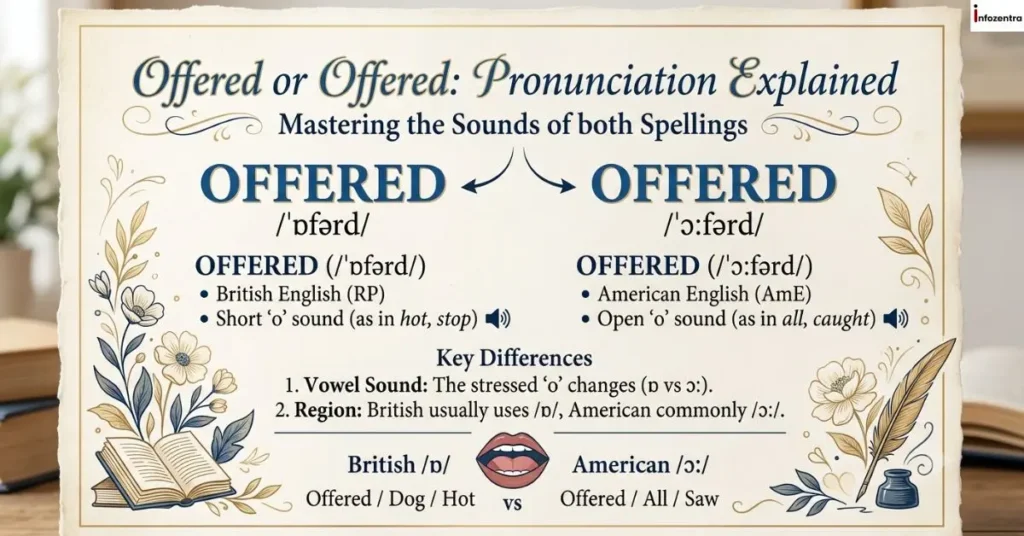
Understanding pronunciation can also help clear up the offerred or offered confusion. In American English, “offered” is generally pronounced with emphasis on the first syllable, sounding close to “AW-ferd.” In British English, the pronunciation shifts slightly but still keeps the stress at the beginning of the word.
Because the second syllable is soft and quick in both varieties, some writers mistakenly assume it needs an extra “r” to sound complete. However, phonetic sound alone should never be trusted as the only guide for correct spelling in English, since many English words disconnect spoken sound from written form.
Offerred or Offered in Everyday Sentences
Seeing the correct word used in real example sentences helps train your memory faster than memorizing rules alone. Here are a few natural examples:
- She offered her assistance to a new coworker.
- The company offered a discount to loyal customers.
- He offered a thoughtful suggestion during the meeting.
- The university offered scholarships to top students.
- They offered support after the difficult event.
- The store offered free shipping during the holiday season.
- The manager offered constructive feedback to the team.
Every one of these sentences uses “offered” correctly, and none of them require a double “r.”
Common Mistakes Involving Offerred or Offered
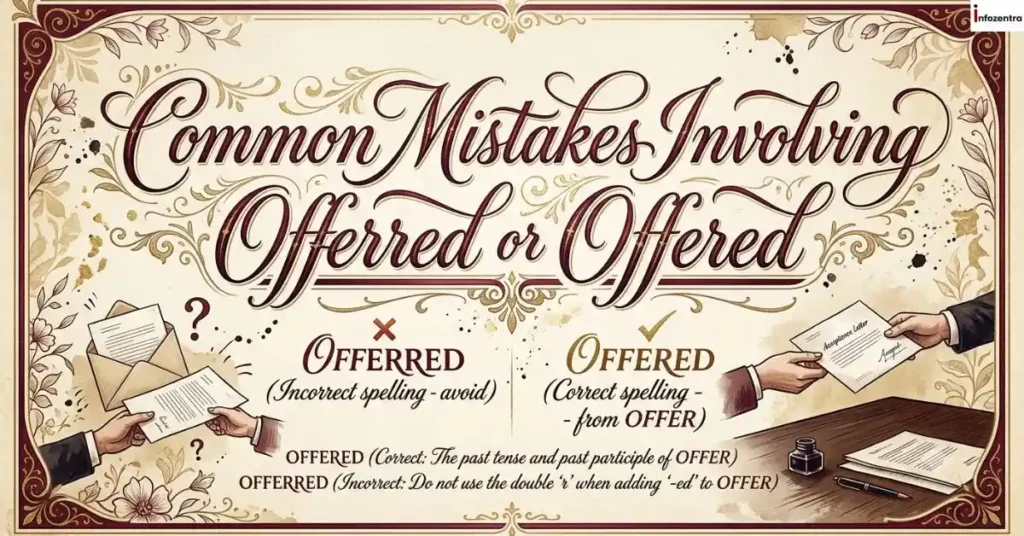
Besides the direct offerred or offered confusion, writers also mix up tenses or misapply similar-sounding grammar patterns. A frequent mistake looks like this: “I offered to help, and now I am offerred to do more.” The correct present-tense form here is “offering,” not “offerred.”
Another mistake happens when people mentally group “offer” with “refer” or “prefer,” assuming all three behave the same way in writing, when only two of them actually double the consonant. These frequently confused words are a major source of spelling mistakes in everyday communication.
Offerred or Offered: A Simple Comparison Table
| Word | Correct Spelling | Reason |
|---|---|---|
| Offer | Offered | Stress on first syllable, no doubling |
| Prefer | Preferred | Stress on final syllable, doubling required |
| Refer | Referred | Stress on final syllable, doubling required |
| Transfer | Transferred | Stress on final syllable, doubling required |
| Occur | Occurred | Stress on final syllable, doubling required |
| Admit | Admitted | Stress on final syllable, doubling required |
| Permit | Permitted | Stress on final syllable, doubling required |
| Commit | Committed | Stress on final syllable, doubling required |
Why Correct Spelling Matters in Professional Writing
Small spelling errors like “offerred” can quietly affect how professional your writing appears. In resumes, emails, business proposals, and academic writing, readers often connect correct spelling with attention to detail, credibility, professionalism, and communication skills.
A single mistake may not change the meaning of a sentence, but it can distract the reader and reduce the overall clarity in writing and writing accuracy of your message. This matters especially in workplace communication, where first impressions with clients, managers, or professors can shape how your work is judged.
Offerred or Offered: Impact on Digital Marketing and SEO Content
Spelling accuracy also plays a role in digital marketing and SEO content. Well-written, error-free content tends to build stronger reader trust, encourage engagement, and support a brand’s credibility with search engines and human readers alike.
On the other hand, visible mistakes such as “offerred” instead of “offered” can create a poor first impression, especially on websites, product descriptions, or social media posts where first impressions matter most.
Businesses that consistently use correct spelling in their marketing copy tend to appear more trustworthy and established.
How Spell Checkers Handle Offerred or Offered
Most modern writing tools, including Grammarly, Microsoft Word, and Google Docs, will automatically flag “offerred” as a spelling mistake and suggest “offered” instead. However, autocorrect tools are not always perfect, especially with fast typing or unusual sentence structures, so proofreading your own writing is still an important habit.
Relying only on a spell checker without reading your own work carefully can still leave small errors unnoticed.
Offerred or Offered: Easy Tricks to Remember the Right Spelling
If you still find yourself hesitating between offerred or offered, try one of these simple memory tricks:
- Say the word slowly: OF-fer. Since the stress is at the beginning, there is no reason to double the ending.
- Compare it to “opened,” which follows the exact same pattern and never doubles its final letter.
- Remember the short rule: if the final syllable is stressed, double the consonant; if not, keep it single.
- Write a few practice sentences using “offered” until the spelling feels automatic.
- Read professionally written content regularly, since frequent exposure builds spelling confidence naturally over time.
Offerred or Offered: Related Words and Synonyms
Depending on the context, several synonyms can be used in place of “offered,” including provided, presented, suggested, proposed, extended, tendered, proffered, furnished, supplied, and handed over.
Understanding these related words can also help you vary your sentence structure while still keeping your spelling accurate. Vocabulary variety, combined with correct grammar, makes your writing feel more polished overall.
Offerred or Offered: Different Contexts Where the Word Appears
The word “offered” shows up across many types of writing and conversation, including workplace communication, customer support messages, scholarship announcements, business discounts, academic opportunities, and casual conversations about giving advice or assistance.
Because it appears so often, learning the correct spelling once saves you from repeating the same mistake in dozens of future situations, across both formal context and informal context writing.
Offerred or Offered: The Psychology Behind the Mistake
Spelling mistakes like offerred usually happen because the brain relies on pattern recognition rather than checking every single letter individually. This mental shortcut speeds up reading and writing but occasionally creates small errors, especially with words that closely resemble other, differently spelled verbs.
This is a normal part of how human memory works, and it is not a sign of poor writing skills. Regular reading and practice naturally correct these small gaps over time by reinforcing the correct visual pattern of a word.
Offerred or Offered: Why English Spelling Feels Inconsistent
English borrows vocabulary from many different languages, including Latin, French, German, and Old English, which is part of why English spelling can feel inconsistent. Some verbs double their final consonant, while others, following the same-looking pattern, do not.
This inconsistency is exactly why confusion around words like offerred or offered continues to appear so frequently, even among experienced writers.
My Final Thoughts:
The debate between offerred or offered has a clear and simple answer: “offered” is correct, and “offerred” is not a recognized word in standard English. The confusion mainly comes from comparing “offer” to similar-looking verbs that follow a different stress pattern.
Once you remember that “offer” stresses its first syllable, the single “r” spelling becomes easy to recall every time you write it, whether in a professional email, an academic paper, marketing content, or everyday conversation.
With a little practice and attention, this small spelling detail becomes second nature.
FAQs
Is it offerred or offered?
The correct spelling is offered. Offerred is a misspelling and is not accepted in standard English.
Why is “offered” spelled with one “r”?
Offered comes from the verb offer. When forming the past tense, you simply add -ed, resulting in offered, not offerred.
What does offered mean?
Offered is the past tense and past participle of offer. It means to present, provide, or make something available to someone.
Can I use “offerred” in formal writing?
No. Offerred is incorrect and should never be used in academic, professional, or everyday English writing.
How can I remember the correct spelling of offered?
Remember that offer already ends with one r. Simply add -ed to make offered—there is no need to add an extra r.
About the Author