
Enquire the Right Way: Complete Guide 2026
Making an enquiry sounds simple — you have a question, you ask it, and you wait for an answer. But anyone who has sent a message that never got a reply, or received a vague response that didn’t actually solve their problem, knows that learning to enquire the right way is a skill in itself.
In 2026, with businesses juggling emails, live chat, WhatsApp, social media DMs, and AI chatbots all at once, how you frame your enquiry can be the difference between getting a fast, useful answer and getting lost in someone’s inbox for a week.
This guide breaks down exactly how to enquire the right way — whether you’re a customer reaching out to a company, a student contacting a university, a job seeker following up with HR, or a business owner requesting a quote from a vendor.
Also Read: Offerred or Offered Correct Spelling and Easy Guide 2026
Why Enquiring the Right Way Matters
Most people treat an enquiry as an afterthought — a quick message dashed off between other tasks. But the person or team on the receiving end is usually dealing with dozens, sometimes hundreds, of similar messages every day.
A poorly framed enquiry gets deprioritized, misunderstood, or bounced back with a request for more information, which just adds another round trip to the conversation.
A well-framed enquiry, on the other hand, gets answered faster because it does the reader’s work for them. It tells them exactly what you need, gives them the context to answer without guessing, and makes it easy to act.
This isn’t about being overly formal or writing an essay — it’s about being clear, specific, and respectful of the other person’s time.
In 2026, response times have become a competitive factor for many businesses, and companies increasingly reward well-structured enquiries with faster, more accurate replies because they’re simply easier to process, whether by a human agent or an automated system.
Know What You Want Before You Enquire

The biggest mistake people make is enquiring before they’ve figured out what they actually need. This leads to messages like “Hi, just wanted to check on this” without saying what “this” is, or asking three unrelated questions in one message that each need a different department to answer.
Before you write anything, take thirty seconds to answer three questions for yourself:
- What outcome do I want from this enquiry — information, a quote, a resolution, a callback?
- What does the other person need to know to give me that outcome?
- Is there a deadline or urgency I should mention?
Once you’re clear on these, the enquiry practically writes itself. This small planning step also prevents the frustrating cycle of sending a message, getting a clarifying question back, and having to explain your situation all over again.
Also Read: Spell Acquaintances Correctly: Easy Trick to Remember 2026
Choosing the Right Channel for Your Enquiry
Not every enquiry belongs on every platform. Sending a complex technical question through a social media DM often means it gets seen by a community manager who isn’t equipped to answer it, while a simple availability check doesn’t need a formal email.
A few general rules that still hold true in 2026:
- Email works best for anything that needs documentation, attachments, or a paper trail — bookings, complaints, formal requests, or anything involving money.
- Live chat or chatbots are suited to quick, well-defined questions like order status, opening hours, or basic troubleshooting.
- Phone calls are still the fastest route for urgent matters or anything requiring back-and-forth clarification that would take too long over text.
- Contact forms on websites are often routed automatically to the right department, so they can be more efficient than a general email address for company-specific enquiries.
- Social media is best reserved for public visibility on issues that haven’t been resolved through other channels, not as a first point of contact.
Picking the right channel isn’t just about convenience — it directly affects how quickly and accurately you get a response, since each channel is typically staffed and monitored differently.
Also Read: Transfer Short Form: Meaning, Examples & Full Guide 2026
Structure of a Well-Written Enquiry
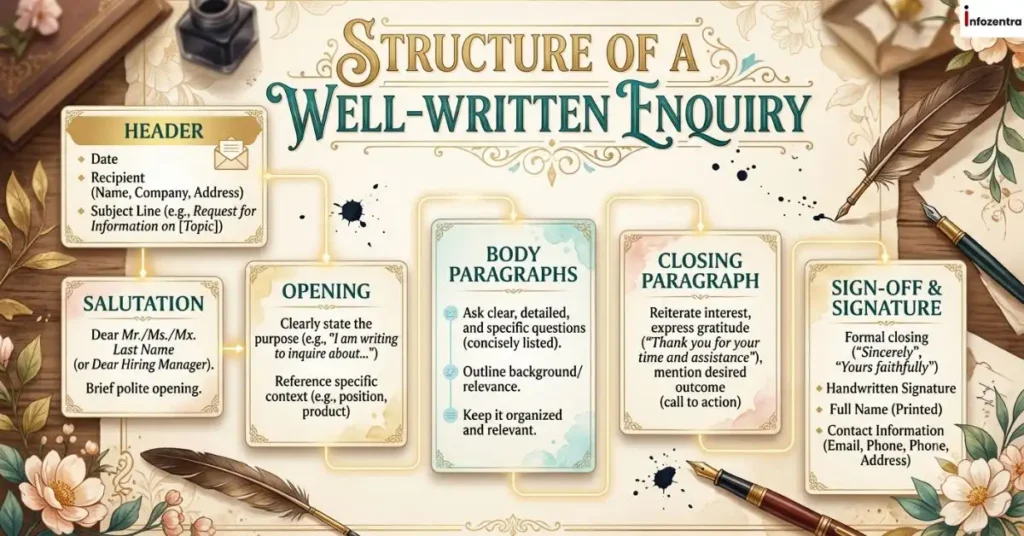
Regardless of the channel, a good enquiry tends to follow a similar shape. Here’s a structure that works for almost any situation:
- A clear subject line or opening line that states the topic in a few words, so the reader knows what they’re dealing with before they even open the message fully.
- A brief introduction — who you are and, if relevant, your relationship to the organization (existing customer, prospective client, applicant, etc.).
- The specific question or request, stated plainly and without burying it under unnecessary detail.
- Relevant context — order numbers, dates, reference IDs, or prior correspondence that helps the reader locate your case quickly.
- What response you’re expecting — information, confirmation, a callback, or next steps.
- A polite closing with your contact details, in case they need to reach you a different way.
This structure keeps the enquiry scannable, which matters because most people skim before they read in full. A recipient should be able to understand your entire request within the first ten seconds of opening your message.
Common Mistakes That Slow Down Your Enquiry
A few habits consistently delay replies, even when the person answering is willing and able to help quickly:
- Vague subject lines like “Question” or “Enquiry” that give no indication of urgency or topic.
- Multiple unrelated questions in a single message, which often means only part of it gets answered, or it gets sent to the wrong team entirely.
- Missing reference details, forcing the recipient to ask follow-up questions just to locate your account or order.
- Overly long messages that bury the actual question in paragraphs of backstory.
- No clear ask at all — describing a situation without stating what you want done about it.
- Sending the same enquiry through multiple channels at once, which often creates duplicate tickets and actually slows down resolution rather than speeding it up.
Avoiding these alone can cut response times significantly, because the recipient doesn’t need to go back and forth just to understand the request in the first place.
How to Enquire Through AI Chat Assistants in 2026
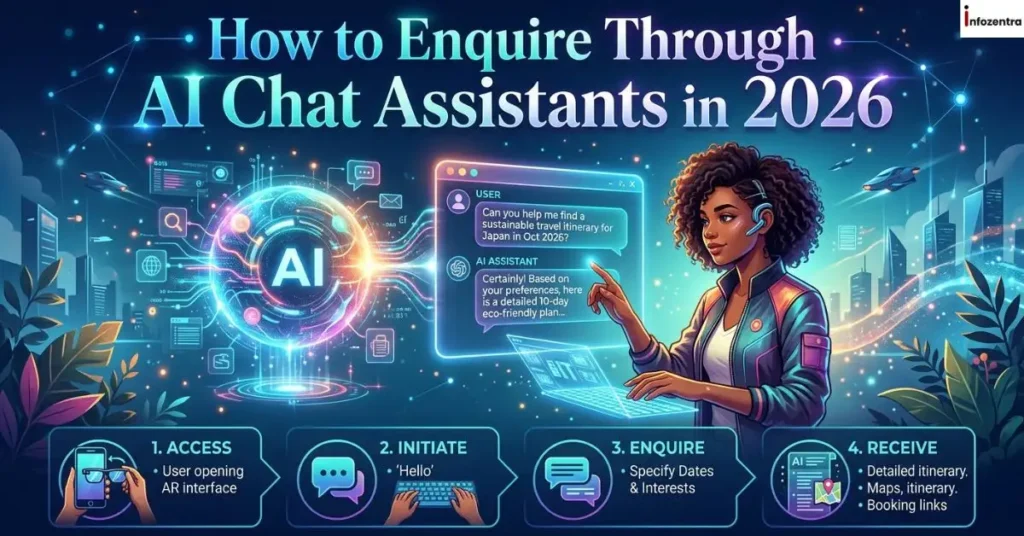
By 2026, a large share of first-line enquiries — on retail sites, banks, telecom providers, and even government portals — are handled by AI-powered chat assistants before a human ever sees the conversation. These systems are good at structured, specific questions but tend to struggle with vague or multi-part ones.
To get the most out of them:
- State your issue in one clear sentence before adding detail.
- Include exact details like order numbers, dates, or account references upfront rather than waiting to be asked.
- Avoid sarcasm, slang, or overly casual phrasing, since these systems interpret literal meaning more reliably than tone.
- If the assistant clearly can’t resolve something, ask directly to be transferred to a human agent rather than repeating the same question in different words.
Treating an AI assistant like a smart search tool that needs precise input, rather than a person who already knows your history, tends to get noticeably better results and shortens the path to a real resolution.
Following Up on an Enquiry Without Being Annoying
Sometimes an enquiry genuinely gets missed. Following up is reasonable — but how and when you do it matters. A good rule of thumb is to wait for the timeframe the organization gave you (or a standard two to three business days if none was given) before following up.
When you do, reference your original enquiry directly — the date you sent it, any reference number, and a short recap of the question — rather than starting from scratch. This makes it easy for whoever picks it up to see the full picture immediately, instead of treating it as a brand-new request.
Avoid sending multiple follow-ups in quick succession, and avoid escalating to a different channel, such as calling after already emailing, unless the matter is genuinely time-sensitive. Persistence helps, but repetition without new information usually just adds noise to an already busy queue.
Enquiry Etiquette Across Different Situations
Customer service enquiries should include your order or account number, the specific issue, and what resolution you’re looking for — refund, replacement, or explanation.
Business or vendor enquiries should state your requirements clearly, including quantities, timelines, and budget range if relevant, so the vendor can respond with an accurate quote rather than a generic one.
Job or HR enquiries should reference the specific role or application, and keep the question narrow — asking about interview timelines is different from asking about the role itself, and mixing both often means only one gets answered properly.
Academic or institutional enquiries benefit from stating your student or applicant status upfront, along with any relevant ID numbers, since these are usually handled by high-volume, understaffed teams working through large queues.
Tone and Language That Make Enquiries Effective
Tone matters almost as much as content. A polite, direct tone tends to get better results than one that’s either overly stiff or overly casual. Being courteous doesn’t mean being wordy — a short “thank you for your help” carries the same warmth as a longer paragraph, without slowing the reader down.
It also helps to avoid sounding accusatory even when you’re frustrated. Framing a delay or issue factually, rather than emotionally, keeps the focus on resolving the problem rather than managing a tense exchange. Recipients, whether human or automated, generally respond faster and more helpfully to enquiries that are calm, specific, and solution-focused.
My Final Thoughts:
Enquiring the right way isn’t about following a rigid script — it’s about respecting the other person’s time while making sure your own needs are clearly understood. A focused, well-structured enquiry almost always gets answered faster and more accurately than a vague one, regardless of the channel or year.
As communication continues to shift toward hybrid human-AI systems in 2026, this clarity matters even more, since both machines and people respond best to requests that say exactly what they mean.
FAQs
What does “enquire” mean?
“Enquire” means to ask for information, details, or clarification about something. It is commonly used in formal and everyday communication.
How do I enquire about a product or service?
You can enquire by contacting the company through email, phone, live chat, or an online contact form. Be clear about the information you need.
Is “enquire” different from “inquire”?
Yes, the difference is mainly regional. “Enquire” is more common in British English, while “inquire” is preferred in American English. Both words have the same meaning.
When should I use the word “enquire”?
Use “enquire” when you want to request information, ask a question, or seek clarification in personal, academic, or business situations.
What is the best way to make an enquiry?
The best way to make an enquiry is to be polite, specific, and concise. Clearly explain what information you need and include any relevant details to help the recipient respond accurately.
About the Author