BackToFrontShow: Complete Guide, Features & Pricing 2026
If you’ve searched for BackToFrontShow recently, you’ve probably noticed something strange: the name pulls up more than one kind of result. Some pages describe a podcast analytics platform. Others describe an online business training program.
And a few older pages reference a web development podcast that shares almost the exact same name. This guide untangles all three, but its main focus is the one people search for most in 2026 — the BackToFrontShow podcast analytics and audience intelligence platform, what it costs, how it compares to competitors, and who it’s actually built for.
Also Read: Hazevecad04 Online: Complete Guide & Features 2026
What Is BackToFrontShow?
BackToFrontShow, commonly shortened to BTFS, is a podcast analytics and audience intelligence platform built for creators and networks who need more than download counts.
Instead of just tracking how many people hit play, BackToFrontShow tracks what happens after that — episode drop-off points, average listening time, demographic segmentation, and engagement signals across an entire show.
Rather than replacing a creator’s hosting provider, BackToFrontShow integrates through an analytics layer that sits over the existing distribution feed.
It pulls behavioral data, firmographic data, and cross-platform attention metrics from the raw listener base, turning that information into something closer to editorial intelligence than a simple dashboard.
The pitch is straightforward: download numbers alone are a vanity metric. Two episodes with identical download counts can perform completely differently once you look at listen-through rate, drop-off timing, and audience segmentation. BackToFrontShow exists to surface that difference.
How BackToFrontShow Fits Into the Podcast Analytics Space
Podcast analytics is a crowded category. Spotify, Apple, Podtrac, Chartable, Buzzsprout, and Captivate all offer some version of listener data. What sets BackToFrontShow apart, according to its own positioning, is depth — specifically, the behavioral layer and the addition of AI-driven insights on top of standard listener metrics.
Podcast listenership has crossed well over 600 million people globally, and the wider podcast market is projected to grow from roughly $30 billion to more than $80 billion by the early 2030s, expanding at a compound annual growth rate near 20%.
That kind of growth is exactly why audience intelligence tools like BackToFrontShow have become more relevant. As more advertising money flows into podcasting, brands increasingly want behavioral proof that their sponsorship dollars are reaching engaged listeners, not just a download count.
BackToFrontShow reports strong engagement growth and high user satisfaction among its active base, along with coverage across more than a dozen countries — a detail that matters for internationally distributed shows that need regional demographic data rather than a single flat number.
Also Read: Tubehalote: The Full Truth Revealed 2026
BackToFrontShow Pricing: A Full Breakdown
This is usually the first question anyone asks, and the honest answer is that BackToFrontShow pricing is not built for a budget audience.
BackToFrontShow pricing starts at around $1,200 per month for the Basic plan. The Pro plan sits at approximately $3,600 per month. Enterprise pricing is fully custom, negotiated based on data ingestion volume, integration complexity, and dedicated API needs.
Here’s what each tier generally includes:
- Basic plan – Foundational demographic and engagement intelligence. Strong enough on its own to support advertiser conversations and improve sponsorship rates for shows that already generate meaningful revenue.
- Pro plan – The most popular tier among agencies and growing content teams. It adds listener behavior tracking, advanced segmentation, and episode-level performance metrics that feed directly into content strategy decisions.
- Enterprise plan – Built for networks that need absolute scale. Because BackToFrontShow pulls complex firmographic and cross-platform attention metrics, this tier requires a steady data processing workflow that only larger operations tend to need.
Because of this pricing structure, individual single-show creators frequently find the entry barrier steep compared to standard hosting add-ons.
A show pulling a couple thousand downloads per episode is unlikely to see a return on a $1,200-a-month tool, while a network running six or seven shows with real advertiser relationships might find the investment easy to justify.
BackToFrontShow vs Competitors: How the Data Compares
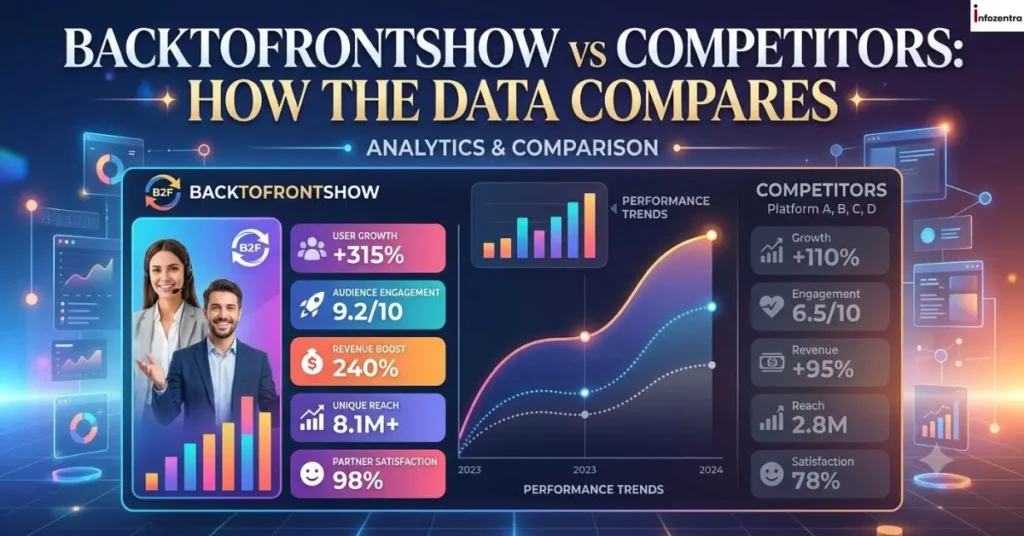
When people compare BackToFrontShow against other analytics tools, the differences tend to show up around one core idea: depth of behavioral data versus breadth of ecosystem reach.
- Chartable focuses on SmartLinks and ad attribution tracking, which makes it a favorite for growth marketing teams, but it’s noticeably lighter on deep behavioral drop-off analysis.
- Podtrac is treated as something close to an industry standard for audience verification, especially for multi-show advertising networks, though its dashboard can feel thin when it comes to qualitative data.
- Spotify Analytics offers strong native engagement and retention loops, but it’s locked entirely inside the Spotify ecosystem, which limits its usefulness for independent platform creators publishing everywhere else.
- BackToFrontShow leans hardest into behavioral drop-offs and AI-driven sentiment analysis, positioning itself for large networks and B2B brands rather than solo creators, with a correspondingly high enterprise price ceiling.
None of these tools is objectively “best” across every use case. The right choice depends heavily on whether a creator needs ad attribution tracking, audience verification for advertisers, or deep behavioral data for internal content strategy.
Also Read: Social Media Stuff EmbedTree: Full Guide & Setup Tips 2026
Who Should Actually Use BackToFrontShow?
Not every podcaster needs what BackToFrontShow offers, and the platform’s own pricing structure makes that pretty clear.
BackToFrontShow tends to make the most sense for:
- Brands spending serious money on podcast sponsorships that need behavioral data to justify the spend internally to stakeholders.
- Media companies running several shows simultaneously that need cross-show audience comparison rather than isolated, per-show numbers.
- Digital agencies managing podcast or audio content for multiple clients that need reporting they can actually present in a client meeting.
For most independent creators or hobby shows, a combination of free tools plus something like Podtrac or Captivate will deliver solid value without the overhead that comes with BackToFrontShow pricing.
If you’re just getting started, the entry cost will feel out of reach, and that’s a reasonable read on the situation rather than a failure on your part. There’s also a content-strategy angle worth noting. In 2026, podcast analytics and SEO strategy increasingly overlap.
Media brands are using listener data to fuel link-worthy articles, authority-building case studies, and original research that earns organic backlinks at scale. BackToFrontShow sits directly at that intersection, treating listener data less like a report and more like raw material for content intelligence.
What Podcast Creators Consistently Get Wrong About Analytics
A recurring mistake among podcasters — one that BackToFrontShow’s own materials point to directly — is treating download numbers as the primary success metric. It feels intuitive: more downloads should mean more reach. But downloads without behavioral context don’t say much about actual performance.
A 40-minute episode with 8,000 downloads and a 70% listen-through rate is generally more monetizable than one with 15,000 downloads and a 30% completion rate. Advertisers care about attention, not just impressions.
BackToFrontShow tracks drop-off points, average listening time, and engagement signals per episode specifically to close that gap. That data lets creators make real editorial decisions: changing an intro format, testing a different episode length, or identifying which topic clusters retain listeners versus which ones bleed audience in the first few minutes.
That’s the difference between analytics as a vanity dashboard and analytics as genuine editorial intelligence.
The Outlook for BackToFrontShow in 2026 and Beyond

Podcasting as an industry is maturing quickly. With the market projected to keep growing at a fast pace through the early 2030s, ad budgets are expected to keep shifting further into audio, and brands will keep demanding more sophisticated performance data from the creators they sponsor.
That pressure is likely to push more professional shows toward tools like BackToFrontShow rather than away from them.
The addition of AI-driven insights to the platform’s stack — automated content recommendations based on listening behavior, predictive audience growth modeling, and smarter ad placement triggers — signals where BackToFrontShow and similar tools are heading.
For now, it occupies a fairly specific niche: premium intelligence for professional podcast operations that can’t afford to guess about their audience, rather than a general-purpose tool for every show.
A Different BackToFrontShow: The Online Business Training Platform
Here’s where things get confusing, and it’s worth addressing directly. Separate from the analytics product, there’s also a BackToFrontShow associated with online business training — a show-and-course hybrid that teaches people how to build and grow online businesses, covering topics like websites, email list building, selling digital products, and driving website traffic.
This version of BackToFrontShow pricing follows a completely different structure:
- Free Starter – $0/month, limited episodes and basic guides, no community access.
- Core Access plan – $29/month or $249/year, full episode library, worksheets, and email support.
- Growth Plan – $59/month or $499/year, everything in Core plus live Q&A sessions and group coaching.
- Pro Member plan – $99/month or $899/year, all features plus a monthly one-on-one session and priority support.
- Lifetime Deal – a one-time payment of $497 for lifetime access to all current and future content.
Most paid tiers here come with a 30-day money back guarantee, which lowers the risk for anyone testing the waters. The Core Access plan tends to be the most popular starting point for beginners, while the Growth Plan’s live Q&A and group coaching format works well for people who got stuck trying to build something on their own.
The Pro Member tier’s one-on-one coaching is generally aimed at people running an actual business where time saved from a single good session outweighs the monthly cost.
This is a completely different product from the analytics platform described earlier, and the pricing gap makes that obvious — a $29 monthly training plan and a $1,200 monthly enterprise analytics tool are not serving the same audience.
If you’re researching BackToFrontShow pricing, it’s worth double-checking which version a given article is actually describing.
The Original BacktoFrontShow: A Web Development Podcast
There’s a third layer to this naming confusion, and it’s the oldest one. Long before either of the products above, there was a podcast called The Back to Front Show, launched in 2013 by two British web development veterans, Keir Whitaker and Kieran Masterton.
It covered web development, front-end development, web design, and startup culture through loose, unscripted, two-host conversations. That podcast ended in December 2020 after 103 episodes.
The hosts never issued a formal farewell — the show simply went quiet, and more than five years of silence since has made its status clear. Its full episode archive still exists through Listen Notes, and community-preserved copies are also available through SoundCloud and the Internet Archive.
Importantly, the domain that once hosted this podcast no longer belongs to Whitaker or Masterton. It now hosts the unrelated analytics product covered earlier in this guide, with no verified connection between the two.
Signals pointing to this include a contact address using a free Gmail account rather than a business domain, blog content about unrelated topics like online casinos, generic testimonials with no verifiable identities, and no independent press coverage confirming the analytics product’s claims.
The most likely explanation is that the original domain lapsed after the podcast went inactive and was later acquired by an unrelated party looking to benefit from its existing search presence.
BacktoFrontShow (the Podcast) vs The Digital Executive
Since the original BacktoFrontShow podcast still gets discussed, it’s worth briefly comparing it to a currently active show in a similar broad category: The Digital Executive, hosted by Brian E. Thomas, founder of Coruzant Technologies.
Where BacktoFrontShow ran roughly 40-minute conversational episodes between two friends, The Digital Executive runs tight, roughly 10-minute interviews with a single guest each time, covering artificial intelligence coverage, digital transformation, leadership content, and cybersecurity.
The Digital Executive has published more than 1,285 episodes since launching, crossing 1,000 episodes in January 2025, with guest interviews spanning founders and executives from more than 50 countries.
A rough feature comparison:
- Episode depth – BacktoFrontShow wins here; longer, unhurried conversations reach places a 10-minute format can’t.
- Consistency – The Digital Executive wins decisively, with daily publishing sustained over five years.
- Guest expertise – Only The Digital Executive features guests at all, with a wide roster across industries.
- AI coverage – The Digital Executive covers current AI and digital transformation trends extensively; BacktoFrontShow predates the AI boom entirely.
- Developer-specific insight – BacktoFrontShow wins clearly for anyone specifically interested in front-end development and web design culture from its era.
Neither show is really competing with the other. BacktoFrontShow is a finished archive with genuine personality, useful mostly as a historical listen for web practitioners. The Digital Executive is an ongoing daily briefing built for people tracking current leadership and technology trends.
Readers interested in a modern, active podcast ecosystem with regular guest interviews should look toward The Digital Executive; those curious about 2013–2020 web culture can still enjoy the BacktoFrontShow archive, provided they treat its technical references as history rather than current guidance and avoid the unrelated website now using its old domain.
How BackToFrontShow Handles Firmographic and Cross-Platform Data
One detail that separates BackToFrontShow from simpler analytics dashboards is its emphasis on firmographic data and cross-platform attention metrics.
Firmographic data means the platform can attempt to map listener activity back to company-level attributes — industry, company size, or role type — rather than just anonymous demographic buckets like age or region.
For B2B brands, this matters a lot more than it does for a typical entertainment show, because a B2B sponsor cares less about total audience size and more about whether the right kind of professional is actually listening.
Cross-platform attention metrics work in a similar way. Rather than treating Apple Podcasts, Spotify, and independent apps as separate silos of data, BackToFrontShow tries to stitch together a fuller picture of how a single listener engages with a show across different platforms.
This is technically harder than single-platform tracking, and it’s part of why the underlying infrastructure — and therefore BackToFrontShow pricing — sits so much higher than lighter-weight tools.
For a show without any B2B sponsorship ambitions, this feature set may simply be more than what’s needed. But for a media network trying to sell sponsorships into specific industries, or an agency managing shows for enterprise clients, that level of data can directly justify the monthly cost.
Setting Up BackToFrontShow Without Migrating Hosts
A common concern creators raise before adopting any new analytics tool is whether it requires switching hosting providers. BackToFrontShow avoids this by integrating through what it describes as an analytics prefix line layered onto the existing distribution feed, rather than requiring a full migration.
In practice, this means a show can keep its current podcast host, RSS feed, and publishing workflow intact while BackToFrontShow reads the underlying listener behavior data through that added layer.
For larger networks running many shows across different hosts, this matters because a full migration across dozens of feeds would be a massive operational lift on its own, separate from any analytics value.
Being able to add a data intelligence layer without disrupting an existing publishing pipeline is one of the more practical advantages of this kind of setup, even before considering the behavioral insights themselves.
Comparing BackToFrontShow Pricing to the Overall Cost of Podcast Growth
It’s worth putting BackToFrontShow pricing in context against what shows already spend to grow. A single podcast network running ad campaigns, hiring editors, and paying for hosting can easily spend several thousand dollars a month before analytics even enter the picture.
Against that backdrop, a $1,200 to $3,600 monthly analytics layer is a meaningful but not outlandish addition — provided the show is already generating revenue that the data can help protect or grow.
The calculation looks different for a show still building its early audience. In that stage, the priority is usually more basic: growing download numbers, building an email list, and establishing a consistent publishing schedule.
Deep behavioral data and AI-driven sentiment analysis solve a later-stage problem — proving value to advertisers and optimizing content that already has an audience — rather than an early-stage problem of finding listeners in the first place.
That’s the core reasoning behind treating BackToFrontShow as a tool for scale rather than a starting point.
Content Strategy and SEO Uses for BackToFrontShow Data
Podcast analytics increasingly feed into more than just internal decision-making. Media companies have started treating listener data as a form of content intelligence that can support a broader SEO strategy.
Original research drawn from real audience behavior — listener retention by topic, demographic breakdowns by episode type, or engagement trends across a network — can become the basis for case studies and data-driven articles that other sites want to reference and link back to.
This is part of why BackToFrontShow markets itself as more than an internal reporting tool. A network that can say, with real behavioral data behind it, which topics keep listeners engaged longest has something worth publishing, not just something worth acting on privately.
That kind of original research tends to earn organic backlinks in a way that generic advice content doesn’t, because it’s citing a network’s own numbers rather than repeating industry-wide statistics everyone already has access to.
Whether this justifies the cost of BackToFrontShow pricing on its own depends on how seriously a media brand is investing in content marketing.
For a brand already producing case studies and data-backed articles as part of its growth strategy, having a reliable behavioral dataset behind that content is a real advantage. For a show without that kind of content operation, the SEO angle is more of a bonus than a primary reason to buy.
Common Questions to Ask Before Committing to BackToFrontShow
Before signing on for any tier, it’s worth working through a short list of practical questions, since BackToFrontShow pricing is a real commitment rather than a minor add-on:
- Does the show already have advertiser or sponsorship relationships that would benefit from behavioral proof of engagement, or is monetization still early-stage?
- Is the show part of a network with multiple titles that would benefit from cross-show audience comparison, or is it a single independent production?
- Does the team have the bandwidth to actually act on detailed drop-off and segmentation data, or would it mostly sit unused in a dashboard?
- Is there an existing content marketing or SEO strategy that could use original listener data as source material for case studies and articles?
- Would a lower-cost alternative like Podtrac, Chartable, or Captivate cover the actual need without the enterprise-level cost?
Answering these honestly tends to make the decision clearer than reading a feature list alone. BackToFrontShow is built for a specific kind of operation, and matching that profile matters more than any single feature on its own.
My Final Thoughts:
BackToFrontShow means different things depending on which version of the name you’re actually researching, and mixing them up is easy to do. The analytics platform is a premium, enterprise-level tool built for networks, brands, and agencies that need real behavioral data to justify sponsorship spend and sharpen content strategy — not something a hobby show needs to worry about yet.
The online training version is a much more affordable, beginner-friendly product aimed at people learning to build an online business from scratch.
And the original web development podcast is neither of those things; it’s a finished archive from 2013 to 2020 that’s still worth a listen for anyone curious about that era of the web industry, as long as the current domain isn’t mistaken for the real thing.
If you’re evaluating BackToFrontShow pricing for the analytics product specifically, the decision really comes down to scale. Shows and networks that already have advertiser relationships, multiple titles, or a serious content marketing operation tend to get real value out of the behavioral data and AI-driven insights on offer.
Everyone else is usually better served starting with a more affordable tool and revisiting BackToFrontShow once the show has grown into the kind of operation this platform was actually designed for.
FAQs
What is BackToFrontShow?
BackToFrontShow is a podcast analytics platform that helps creators track audience demographics, listening behavior, engagement, device usage, and episode performance through detailed analytics and reporting tools.
What features does BackToFrontShow offer?
BackToFrontShow includes listener demographics, engagement tracking, geographic analytics, device analytics, customizable reports, AI-powered insights, and real-time dashboards to help podcasters grow their audience.
How much does BackToFrontShow cost?
BackToFrontShow offers multiple pricing plans, including a Basic plan, a Pro plan, and a custom-priced Enterprise plan with advanced analytics and integrations for larger teams.
Who should use BackToFrontShow?
BackToFrontShow is designed for podcasters, podcast networks, media companies, marketers, and businesses that want deeper audience insights and data-driven strategies to improve podcast performance.
Is BackToFrontShow worth using for podcast growth?
If you need more than simple download statistics, BackToFrontShow provides detailed audience intelligence, engagement metrics, and reporting features that can help optimize your content strategy and grow your podcast more effectively.
About the Author