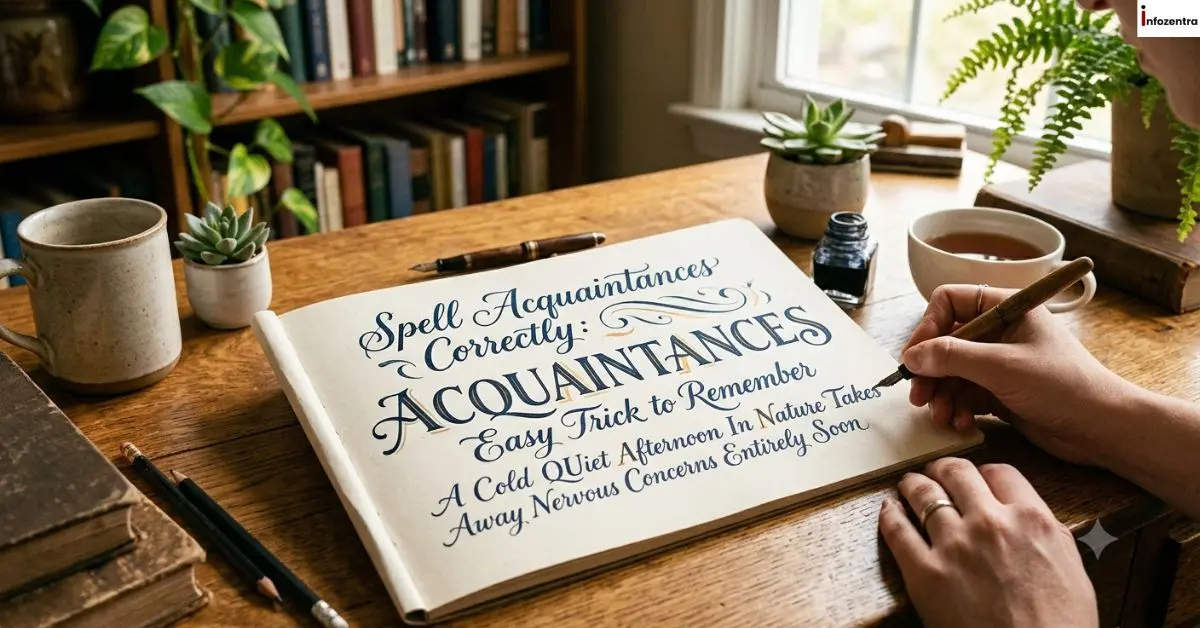
Spell Acquaintances Correctly: Easy Trick to Remember
Have you ever paused in the middle of writing a sentence, unsure whether it’s “aquaintances,” “acquaintences,” or “acquaintances”? You are not alone.
This is one of the most commonly misspelled words in the English language, and even confident writers second-guess themselves when they reach it. The good news is that once you understand why people get confused and learn one simple memory trick, you will never have to hesitate again.
In this article, we will break the word down piece by piece, look at why it trips people up so often, and give you several practical ways to make sure you spell acquaintances correctly every single time you write it.
Also Read: Transfer Short Form: Meaning, Examples & Full Guide 2026
Why Do People Struggle to Spell Acquaintances?
The word comes from the French term “acointance,” which itself traces back to Latin roots connected to the idea of becoming familiar with something or someone. Because of this history, the spelling does not always match the way we pronounce it in everyday speech.
Many people drop the “c” after the first “a,” write only one “c” instead of two, or forget the “ai” combination in the middle. Others accidentally add an extra “e” before the ending, or swap the order of letters without even realizing it.
These small slips happen because the word has several tricky letter combinations packed close together, and English spelling rarely gives us a phonetic shortcut for words with this kind of layered history. Another reason this word causes so much trouble is length.
Long words naturally increase the chance of error because there are simply more letters to get right. When a word stretches past ten or twelve letters, our brains tend to rely on memory of the overall “shape” of the word rather than each individual letter, which is exactly how small mistakes slip through unnoticed until someone else points them out.
Also Read: Enquire the Right Way: Complete Guide 2026
The Spell Acquaintances
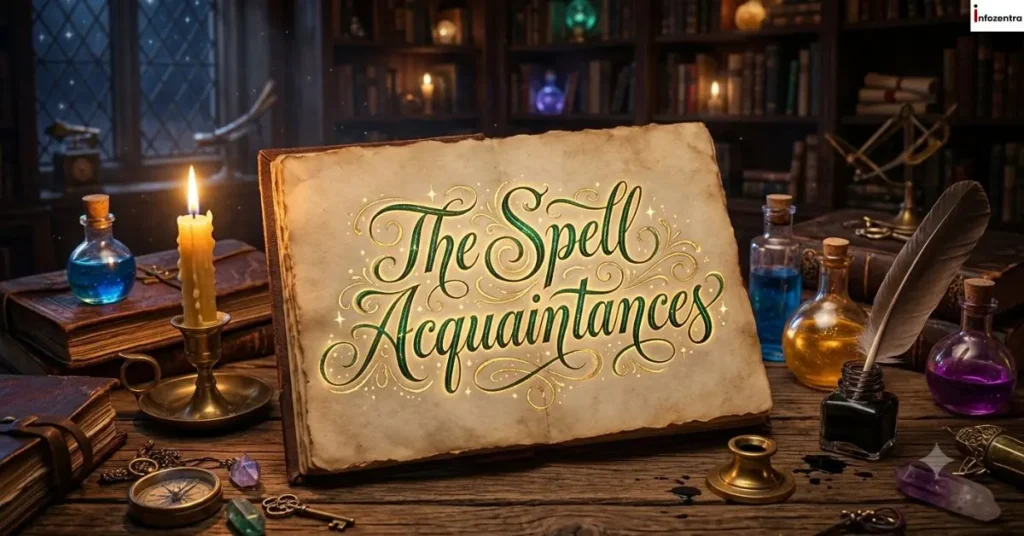
The right way to write it is: a-c-q-u-a-i-n-t-a-n-c-e-s. Notice that it contains “quaint” right in the middle of the word. This single observation is the foundation of the easiest trick you will ever learn for this word.
Once this pattern clicks in your mind, the entire spelling becomes far less intimidating, because instead of thirteen random letters, you are really only dealing with three manageable chunks joined together.
The Easy Trick to Remember Spell Acquaintances Correctly
Look closely at the middle section of the word: a-c-quaint-ances. If you already know how to spell “quaint,” meaning old-fashioned or charming, you already know the hardest part of this word. Simply add “ac” to the front and “ances” to the back, and you have your answer.
Think of it this way: your acquaintances are people you know in a light, casual way, almost like a “quaint” little connection rather than a deep friendship. Picturing this small mental image links the meaning of the word to its spelling, which makes it far easier to recall under pressure, whether you are writing an email, an essay, or a text message.
Memory experts often say that the brain holds onto stories and pictures far better than it holds onto random letter sequences, and this trick works precisely because it turns a spelling problem into a tiny, memorable idea.
You can even say the sentence out loud the next time you are unsure: “My acquaintances are quaint.” It sounds a little unusual, but that strangeness is actually helpful, because unusual phrases tend to stick in memory far longer than plain, ordinary ones.
Also Read: Offerred or Offered Correct Spelling and Easy Guide 2026
Breaking the Word Into Smaller Parts

Another helpful approach is to split the word into three short chunks instead of trying to memorize it all at once:
- AC – the beginning sound
- QUAINT – the familiar middle word
- ANCES – the closing sound
Say each chunk slowly out loud a few times. Breaking a long word into smaller, familiar pieces is a technique used by teachers and language learners around the world because it reduces the mental load of remembering many letters in a row. Instead of asking your brain to hold thirteen letters in order, you are only asking it to hold three short, familiar pieces, which is a much lighter task.
This chunking method is not limited to this one word either. Many long English words become far less scary once you learn to notice smaller, familiar words hiding inside them. Training your eye to spot these patterns is a skill that will help you with vocabulary far beyond just this single example.
Common Misspellings to Watch Out For
Here are a few incorrect versions that often slip past a quick glance:
- Aquaintances (missing the “c”)
- Acquaintences (wrong vowel in the middle section)
- Aquaintences (missing the “c” and wrong vowel)
- Acquaintanses (wrong ending)
- Aquaintanses (multiple errors combined)
If any of these look familiar to you, do not worry. Recognizing your own past mistakes is actually a strong step toward permanently fixing them.
Most people who misspell this word are not being careless; they are simply relying on how the word sounds rather than how it is actually built, and sound alone is a poor guide for this particular word.
Why This Word Matters in Everyday Writing

The word “acquaintances” shows up more often than you might expect. It appears in professional emails when networking, in college application essays describing social circles, in casual conversation about new coworkers, and in formal writing such as reports or articles. \
Because it is used so widely across both casual and professional contexts, getting the spelling wrong can quietly undermine how careful and polished your writing appears, even if the rest of your message is well written.
A single misspelled word in an otherwise strong email or document can distract a reader and shift their attention away from your actual message.
This is especially true in situations like job applications, cover letters, or business communication, where small errors are sometimes read as a lack of attention to detail. Learning to spell this word correctly, along with a handful of other commonly misspelled words, is a small investment that pays off in how confidently and professionally your writing comes across.
A Simple Sentence to Practice With
Try writing this sentence a few times by hand or on your keyboard: “I met several new acquaintances at the community event last weekend.” Repetition, especially when paired with the “quaint” trick above, helps train your memory so the correct spelling becomes automatic rather than something you have to think through every time.
You might also try writing a few sentences of your own using the word in different contexts, such as describing acquaintances from school, from work, or from a hobby group. The more contexts in which you actively use the word yourself, rather than simply reading it, the faster it becomes part of your natural vocabulary.
Extra Tips to Lock In the Spelling
Beyond the main “quaint” trick, a few additional habits can help reinforce the correct spelling over time:
- Write the word slowly by hand a few times instead of only typing it, since handwriting tends to build stronger memory connections.
- Read the word aloud syllable by syllable: ac-quaint-anc-es.
- Keep a small personal list of words you often misspell, and review it occasionally.
- Use the word in a sentence about your own life, since personal relevance makes memory stronger.
- Notice the word whenever you come across it in books, articles, or emails, and quietly check the spelling in your mind.
None of these tips require special tools or classes. They simply ask you to slow down for a moment and pay a little extra attention the next few times you encounter the word, until the correct pattern feels natural.
My Final Thoughts:
Learning to spell acquaintances correctly does not require memorizing complicated rules. It simply requires spotting the small, familiar word hiding inside it. Once you notice “quaint” tucked into the middle, the rest falls into place naturally, and the word stops feeling like a spelling challenge at all.
The next time you introduce someone as an acquaintance or write about the people you have recently met, you can do so with complete confidence in your spelling, knowing that a simple mental picture and a little practice are all it takes to get it right every time.
FAQs
How do you spell acquaintances?
The correct spelling is acquaintances. It is the plural form of acquaintance, meaning people you know but are not close friends with.
Why is “acquaintances” difficult to spell?
Many people misspell acquaintances because it contains silent letters and an uncommon letter sequence: ac-quain-tances.
What is the easiest way to remember how to spell acquaintances?
Break it into smaller parts: ac + quaint + ances. Practicing it a few times and using it in sentences can help you remember the correct spelling.
What does acquaintances mean?
Acquaintances are people you know casually but do not have a close personal relationship with, such as classmates, neighbors, or coworkers.
What are common misspellings of acquaintances?
Common incorrect spellings include aquaintances, acquantances, acquantances, and acquaintence. The correct spelling is always acquaintances.
About the Author