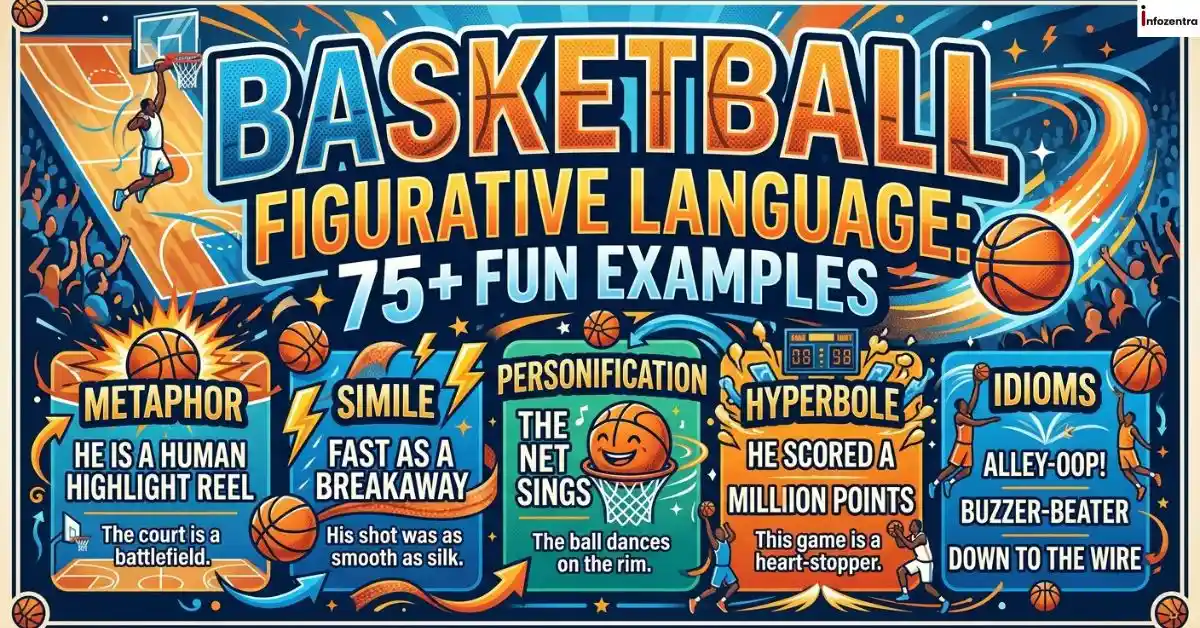
Basketball Figurative Language: 75+ Fun Examples
Basketball moves fast — squeaking shoes, a ball snapping through the net, a crowd rising out of its seats. Plain description can only take a writer so far when trying to capture that kind of energy.
That’s where basketball figurative language comes in. Idioms, similes, and metaphors turn ordinary game action into something readers can feel, not just read about.
This guide explains what basketball figurative language is, why it’s useful, and then gives you 75+ fun examples you can use in essays, sports articles, captions, or everyday conversation.
Also Read: Disregulation Explained: Everything You Need to Know 2026
What Basketball Figurative Language Really Means
Basketball figurative language is any expression that goes beyond a literal description of the game. Instead of saying “the player scored quickly,” a writer might say the player struck “like a rocket off the launch pad.” Nobody is literally a rocket — but the comparison captures speed and force in a way plain language can’t.
This style of writing usually takes one of three shapes:
- Vocabulary-based expressions — basketball terms that carry meaning beyond the court
- Idioms — phrases born on the court and now used in daily life
- Similes and metaphors — comparisons that add color, rhythm, and emotion to writing
Also Read: Enquire the Right Way: Complete Guide 2026
Why Writers Rely on Basketball Figurative Language
A game recap built only from scores and stats is forgettable. One built with vivid comparisons sticks with the reader. Basketball figurative language helps in a few concrete ways:
- Turns fast, chaotic action into a picture the reader can see
- Gives writing rhythm and personality instead of flat, mechanical sentences
- Builds an emotional connection between the reader and the game
- Strengthens vocabulary for English learners looking for natural-sounding phrases
- Makes essays, captions, and articles more memorable and shareable
Also Read: Transfer Short Form: Meaning, Examples & Full Guide 2026
Basketball Figurative Language: 75+ Fun Examples
Below are more than 75 original comparisons, numbered straight through so you can browse, borrow, or use them as a practice list. Each one pairs basketball action with a short explanation of what it means.
- Full-court press — giving something everything you’ve got. “She’s putting a full-court press on her finals prep.”
- Slam dunk — a guaranteed win. “That interview was a slam dunk.”
- Buzzer-beater — finishing at the very last second. “He turned in the report as a total buzzer-beater.”
- Dropping the ball — making a careless mistake. “They dropped the ball on the shipping deadline.”
- Taking a shot — trying something risky. “Go ahead and take a shot at the promotion.”
- Swift like an arrow — the guard shot down the lane swift like an arrow leaving a bow.
- Hit like a freight train — their defense hit like a freight train picking up speed.
- Fast as a hare — the rookie moved fast as a hare bolting from cover.
- Quick like a spark — his first step was quick like a spark jumping a wire.
- Surged like a dam breaking — the offense surged forward like water breaking through a dam.
- Moved like a dance routine — the passing sequence moved like a well-rehearsed dance routine.
- Flowed like a stream — their ball movement flowed like a stream working around rocks.
- Directed play like a musician — the point guard kept time like a conductor.
- Rolled like turning pages — possessions rolled by smoothly, like pages turning in a favorite book.
- Hummed like a tuned engine — their offense hummed along like an engine tuned to perfection.
- Tense as a thunderstorm — the final quarter felt as tense as a thunderstorm building overhead.
- Rose like a wave — the crowd noise rose like a wave about to crash.
- Heavy as a title fight — every possession mattered, as heavy as the final round of a boxing match.
- Played like a heavyweight bout — the rivalry game played out like a heavyweight boxing match.
- Swung like a pendulum — momentum swung back and forth like a pendulum refusing to settle.
- Smooth as glass — his jumper was as smooth as glass sliding across a table.
- Threaded like a needle — she threaded passes through defenders like thread through a needle.
- Precise as a surgeon — the center’s footwork was as precise as a surgeon’s hands.
- Steady as a metronome — his free throw form looked as steady as a metronome.
- Clean as a diver’s entry — the shooting guard’s release was as clean as a diver’s entry into water.
- Worked like clock gears — the starting five worked together like gears inside a clock.
- Shifted like birds in formation — their rotations on defense moved like birds shifting in formation.
- Linked like a chain — the bench and starters worked as one, like links in a single chain.
- Organized like a marching band — their spacing on offense looked as organized as a marching band.
- Natural as old friends — the team’s chemistry felt as natural as old friends finishing each other’s sentences.
- Built like a rolling snowball — the comeback built like a snowball gathering size downhill.
- Spread like wildfire — their run felt unstoppable, like a wildfire spreading through dry brush.
- Caught like kindling — confidence grew with every made shot, like a fire catching kindling.
- Spread like electricity — the energy on the court spread like electricity through a wire.
- Rolled like dominoes — their scoring streak rolled on like dominoes tipping one after another.
- Stood like a wall against a flood — the defense stood firm like a wall built to hold back a flood.
- Fought like a dog with a bone — he fought for the rebound like a dog guarding its bone.
- Burned like a candle in the wind — her determination burned as steady as a candle in the wind.
- Battled like soldiers — the underdog team battled like soldiers refusing to retreat.
- Unshakable as an old oak — their resolve held strong, as unshakable as an old oak in a storm.
- Magic hands — her hands were magic on the ball, weaving past two defenders.
- A blur on the break — he was a blur down the sideline on the fast break.
- A magic trick crossover — the guard’s crossover was a magic trick nobody could solve.
- Pure lightning in transition — their transition offense was pure lightning, gone before the defense could react.
- A loaded spring — his first step was a loaded spring, ready to explode toward the rim.
- A laser jump shot — her jump shot was a laser locked on target.
- A sniper from deep — he was a sniper from beyond the arc all night.
- Solid gold shooting hand — the rookie’s shooting hand was solid gold in the fourth quarter.
- A heat-seeking missile — every shot he took was a heat-seeking missile toward the net.
- Silk scoring touch — her scoring touch was silk, soft off every finger roll.
- A brick wall in the paint — the center was a brick wall under the basket.
- A steel cage defense — their perimeter defense was a steel cage around the arc.
- A shadow on defense — he was a shadow, glued to his man for forty minutes.
- A fortress defense — the team’s defense was a fortress no offense could crack.
- A hawk on loose balls — she was a hawk, circling every loose ball on the floor.
- The conductor of the offense — the point guard was the conductor of the entire offense.
- Passes like arrows — his passes were arrows, finding the smallest gap in the defense.
- The engine of the team — she was the engine driving every possession forward.
- A wide-open map — his vision on the floor was a map only he could read.
- The glue guy — the assist leader was the glue holding five players together.
- A vacuum on the boards — he was a vacuum on the boards, pulling in every miss.
- Magnet hands near the rim — her hands were magnets near the rim.
- A coiled spring under the net — the forward was a spring, coiled and ready on every shot attempt.
- Owned the paint like a landlord — he owned the paint like a landlord collecting rent.
- A wall of arms — she was a wall of arms fighting for position under the basket.
- A machine built to win — this team was a machine, built for one purpose: winning.
- A rollercoaster season — their season was a rollercoaster, full of highs and gut-punch lows.
- A phoenix comeback — the comeback was a phoenix rising from a fifteen-point deficit.
- An orchestra offense — their offense was an orchestra, every player hitting the right note.
- A storybook run — the championship run was a storybook nobody saw coming.
- A cheetah on the break — the wing sprinted like a cheetah chasing down the fast break.
- A chess match on the sideline — the coaches battled like two players locked in a chess match.
- A puzzle box defense — their zone defense was a puzzle box the offense never solved.
- A river of passes — the ball moved through the offense like a river finding its path.
- A drumbeat tempo — their possessions kept a steady drumbeat rhythm all night.
- A firework finish — the buzzer-beater exploded through the crowd like a firework.
- A marathon fourth quarter — both teams dug in like it was the final mile of a marathon.
Also Read: Offerred or Offered Correct Spelling and Easy Guide 2026
Basketball Figurative Language Writing Prompts
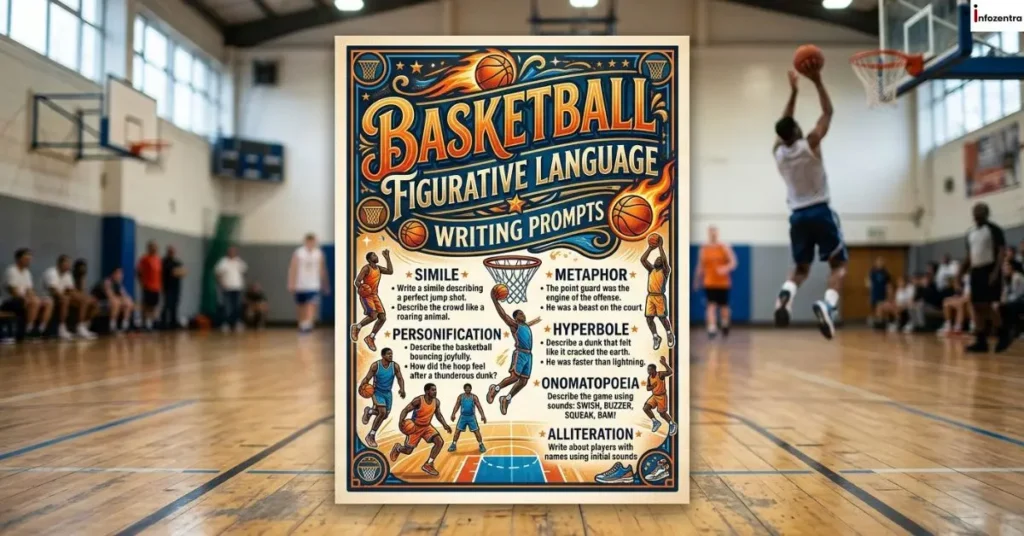
Instead of memorizing lines, try building your own. Pick any one of these short prompts and write two or three sentences using a simile or metaphor of your own:
- Describe a player breaking away for a fast break — what does their speed remind you of?
- Describe a buzzer-beater shot in the final second — what feeling does it capture?
- Describe a team’s defense holding strong in the fourth quarter — what does it feel like to face?
- Describe a comeback from a big deficit — what does the momentum feel like as it builds?
- Describe a point guard controlling the pace of the game — what role are they really playing?
Writing your own comparisons, even rough ones, builds the skill far faster than reading a list of examples. Try reading your sentences out loud afterward — figurative language usually gets stronger once you hear the rhythm of it.
How to Practice Basketball Figurative Language at Home
- Watch highlight clips and describe the action using one simile and one metaphor
- Read sports columns and underline any figurative phrases you notice
- Rewrite a plain sentence about a game three different ways using different comparisons
- Keep a running list of “comparison words” — animals, weather, machines, music — to pull from when writing
My Final Thoughts:
Basketball figurative language turns a fast-moving game into something readers can picture, feel, and remember. Idioms carry basketball’s spirit into everyday speech, while similes and metaphors give writing a punch that flat description can’t match.
Whether the goal is a stronger essay, a livelier game recap, or a more natural feel for English expressions, practicing these tools pays off well beyond the basketball court.
FAQs
What is basketball figurative language?
Basketball figurative language uses literary devices such as metaphors, similes, idioms, personification, and hyperbole to describe basketball players, games, skills, or moments in a more creative and engaging way.
How do you identify basketball figurative language?
You can identify basketball figurative language by looking for words or phrases that compare, exaggerate, or give human qualities to objects. For example, “The defender was a brick wall” is a metaphor, while “The ball flew like a rocket” is a simile.
Why is figurative language used in basketball writing?
Figurative language makes basketball descriptions more vivid, memorable, and exciting. It helps readers visualize the action and better understand players’ performances and game situations.
What types of figurative language are commonly used in basketball?
The most common types include metaphors, similes, idioms, personification, hyperbole, alliteration, and imagery. These techniques add emotion and creativity to basketball stories, commentary, and classroom activities.
How can students learn basketball figurative language?
Students can improve by reading basketball articles, identifying different figures of speech, practicing with real game examples, and creating their own basketball-themed metaphors, similes, and idioms.
About the Author