
Disregulation Explained: Everything You Need to Know 2026
At some point, almost everyone has felt completely overwhelmed by an emotion, unable to calm down, focus, or think clearly, even when the situation didn’t seem to call for that level of reaction.
This experience is often described as it — a state where the body and mind lose their ability to manage emotional or physiological responses effectively.
It’s a term that shows up frequently in psychology, parenting advice, workplace wellness discussions, and increasingly in everyday conversation, but it’s often misunderstood or used loosely.
This guide explains what disregulation actually is, why it happens, how it shows up in daily life, and what genuinely helps when it occurs.
Also Read: Enquire the Right Way: Complete Guide 2026
What Is Disregulation?
Disregulation refers to a reduced ability to manage or control emotional responses, behavior, or physical states in a way that fits the situation. It’s the opposite of regulation, which is the brain and body’s normal process of adjusting arousal, mood, and reaction to match what’s actually happening.
When someone is regulated, they can feel a strong emotion — frustration, sadness, excitement — without being completely taken over by it.
When someone is disregulated, that same emotion can spiral into something that feels unmanageable: a small inconvenience triggers a disproportionate reaction, or a stressful moment leads to a shutdown where thinking clearly becomes almost impossible.
It isn’t a diagnosis in itself. It’s a state, and sometimes a pattern, that can appear on its own or alongside various mental health conditions, developmental differences, or simply periods of prolonged stress.
Also Read: Transfer Short Form: Meaning, Examples & Full Guide 2026
What Causes Disregulation?
There isn’t a single cause of disregulation — it usually results from a combination of biological, psychological, and environmental factors working together.
- Nervous system sensitivity. Some people have a more reactive nervous system, meaning their body shifts into high alert more quickly and takes longer to settle back down.
- Chronic stress or trauma. Ongoing stress, especially unresolved trauma, can lower the threshold at which the body perceives something as a threat, making it more frequent.
- Sleep deprivation. Poor or insufficient sleep significantly reduces the brain’s capacity to manage emotional responses the next day.
- Sensory overload. Loud environments, crowded spaces, or excessive screen time can overwhelm processing capacity, particularly in people who are more sensitive to sensory input.
- Underlying conditions. Conditions such as ADHD, anxiety disorders, autism spectrum differences, and mood disorders are often associated with a higher likelihood of it.
- Hunger, fatigue, or illness. Even basic physical states can lower a person’s ability to stay regulated, which is why irritability often increases when someone is simply tired or hasn’t eaten.
Also Read: Offerred or Offered Correct Spelling and Easy Guide 2026
Disregulation in Children Versus Adults
Disregulation looks different depending on age, largely because the brain’s regulatory systems, particularly the prefrontal cortex, are still developing throughout childhood and adolescence.
In children, it often looks like meltdowns, sudden crying, aggression, or complete shutdown in response to something that seems minor to an adult, like a change in routine or being told no. This isn’t necessarily misbehavior — it often reflects a brain that hasn’t yet built the capacity to self-regulate consistently.
In adults, disregulation tends to look less dramatic on the surface but can be just as disruptive. It might show up as snapping at a colleague over a small mistake, feeling paralyzed by a minor decision, or experiencing a wave of anxiety that seems disconnected from the actual situation.
Because adults are expected to manage themselves independently, disregulated moments are often internalized as personal failure rather than recognized as a nervous system response.
Also Read: Spell Acquaintances Correctly: Easy Trick to Remember 2026
Common Signs of Disregulations
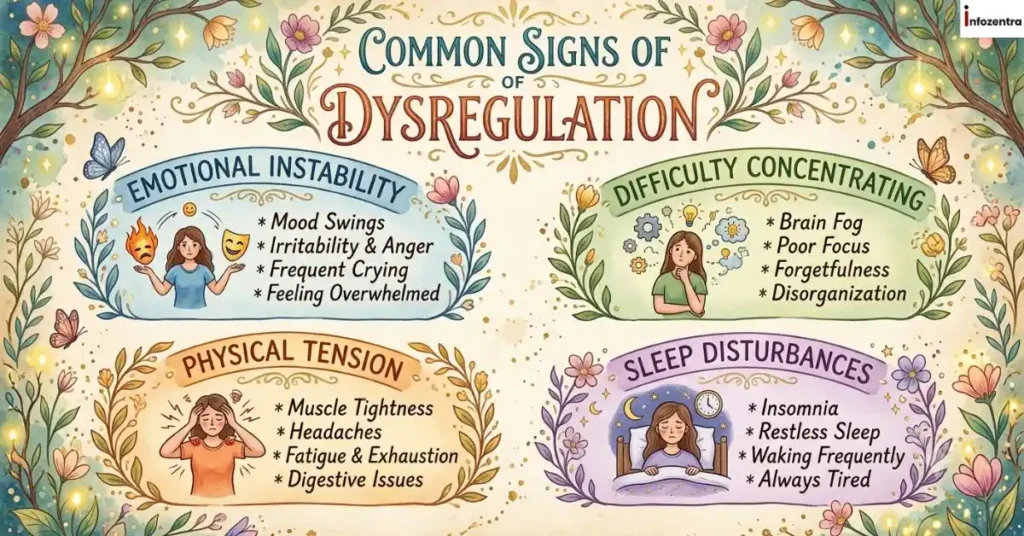
Recognizing disregulation, in yourself or someone else, is the first step toward managing it. Common signs include:
- Reacting intensely to something that wouldn’t normally cause that level of distress
- Difficulty calming down even after the triggering event has passed
- Racing thoughts, or the opposite — feeling mentally blank and unable to think
- Physical symptoms like a racing heart, tight chest, or shallow breathing
- Sudden urges to withdraw, shut down, or avoid the situation entirely
- Impulsive reactions that feel out of proportion once the moment has passed
These signs can appear briefly or persist for extended periods, depending on the underlying cause and how well-supported the person is at the time.
How it Affects Daily Life
When disregulation becomes frequent, it can affect nearly every area of life. Relationships can suffer when reactions feel unpredictable or overwhelming to others. Work performance can decline when focus and decision-making are repeatedly disrupted.
Physical health can be affected too, since chronic disregulation keeps the body’s stress response activated more often than it should be, which over time is linked to fatigue, digestive issues, and a weakened immune response.
For children, ongoing disregulation without support can affect learning, friendships, and self-esteem, particularly if the behavior is consistently misread as intentional defiance rather than a sign that the child needs help building regulation skills.
Disregulation Versus Emotional Reactivity
It’s worth distinguishing Disregulation from ordinary emotional reactivity, since the two are often confused. Everyone reacts emotionally to events — that’s a normal and healthy part of being human.
Disregulation specifically refers to a state where the reaction exceeds the person’s current capacity to manage it, leading to responses that feel involuntary rather than chosen.
In other words, feeling angry is not disregulation. Feeling so overwhelmed by anger that rational thought, communication, or self-control temporarily become inaccessible is closer to what the term actually describes.
How to Support Regulation When Disregulation Occurs
There’s no single fix for it, but several approaches consistently help bring the nervous system back to a more manageable state.
- Slow, controlled breathing. Deliberately slowing the breath signals safety to the nervous system and can shorten the intensity of a disregulated episode.
- Reducing sensory input. Stepping away from noise, bright light, or crowded spaces can give an overloaded nervous system room to settle.
- Naming the state. Simply recognizing and naming what’s happening — “I’m disregulated right now” — can create a small amount of distance from the intensity of the moment.
- Predictable routines. For both children and adults, consistent daily structure reduces the number of unexpected triggers the nervous system has to respond to.
- Physical movement. Activities like walking, stretching, or shaking out tension can help discharge built-up physiological stress.
- Professional support. For frequent or severe disregulation, therapy approaches such as cognitive behavioral therapy, somatic therapy, or occupational therapy can build longer-term regulation skills.
When to Seek Professional Help for Disregulation
Occasional disregulation is a normal part of being human, especially during periods of high stress. However, professional support is worth considering if disregulated episodes are frequent, significantly disrupt relationships or work, involve harm to oneself or others, or don’t seem to improve with basic self-regulation strategies.
A therapist, counselor, or in the case of children, a pediatrician or child psychologist, can help identify whether it is linked to an underlying condition and build a personalized plan to strengthen regulation over time.
My Final Thoughts:
Disregulation isn’t a character flaw or a sign of weakness — it’s a signal that the nervous system has been pushed beyond its current capacity to cope.
Understanding what disregulation looks like, what triggers it, and what genuinely helps can make a significant difference, both in how people respond to their own disregulated moments and how they support others through theirs.
With the right awareness and tools, regulation is a skill that can be strengthened at almost any age.
FAQs
What does disregulation mean?
Disregulation refers to the loss or impairment of normal regulation or control within a system. It is commonly used in medical, psychological, biological, and economic contexts.
What causes disregulation?
The causes of disregulation depend on the context. It may result from genetic factors, illness, stress, injury, hormonal imbalances, or environmental influences that disrupt normal functioning.
What are the common signs of disregulation?
Common signs of disregulation can include difficulty maintaining balance or control in physical, emotional, or biological processes. The symptoms vary depending on the affected system.
How is disregulation treated or managed?
Treatment depends on the underlying cause. It may include medication, therapy, lifestyle changes, stress management, or other targeted interventions recommended by a healthcare professional.
Is disregulation the same as dysregulation?
No. Dysregulation is the widely accepted and commonly used term in medicine and psychology. Disregulation is less common and may appear in some contexts, but it is often used interchangeably with dysregulation depending on the source.
About the Author