

What Is Success? The Answer Most People Miss
What Is Success? Ask ten people to define success and you will get ten different answers. One person will talk about money. Another will talk about happiness. Someone else will mention a degree, a job title, or a house with a paid-off mortgage.
None of them are wrong, and that is exactly the problem. What Is Success? Success has become one of those words we use every day without ever stopping to ask what it actually means to us personally. Most people spend years chasing a version of success that was never theirs to begin with.
They borrow it from a parent, a boss, a friend’s Instagram feed, or a culture that equates achievement with worth. Then they reach the goal, feel strangely empty, and wonder what went wrong. Nothing went wrong. They simply answered the wrong question.
Also Read: Nickel Slick Meaning: Simple Definition & Examples 2026
What Is Success, Really?
The dictionary keeps it simple: What Is Success? success is the accomplishment of an aim or purpose. That definition is technically correct, but it leaves out the part that matters most. Accomplishing a goal only feels like success if the goal was actually meaningful to you.
A better way to think about it is this: success is not a finish line, it is a direction. It is less about arriving somewhere and more about who you become while getting there. The people who feel most fulfilled rarely describe success as a single moment.
They describe it as a process of growth, learning, and showing up again after things go wrong.
Also Read: Transfer Short Form: Meaning, Examples & Full Guide 2026
Why Everyone’s Definition of Success Looks Different
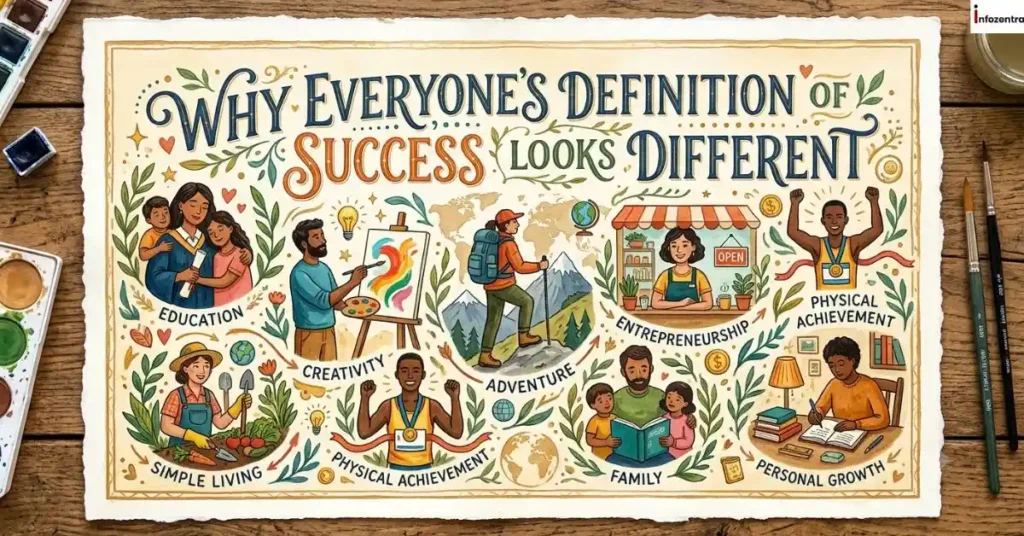
Your values, your priorities, and your life experiences shape what success looks like for you, and that picture will never match anyone else’s exactly. Someone driven by financial security will measure success differently than someone driven by creative freedom or community impact. Neither is more valid than the other.
This is why comparing your progress to someone else’s highlight reel is such a losing game. You are not just comparing outcomes; you are comparing entirely different value systems. The person who looks “more successful” on paper may be quietly unhappy, and the person with the quiet, ordinary life may be living exactly the way they want.
Also Read: Basketball Figurative Language: 75+ Fun Examples
What Is Success Without Happiness?
Here is where it gets interesting. Many of history’s most accomplished people did not equate success with happiness at all. Some described it as movement toward a goal, others as the willingness to fail repeatedly without losing enthusiasm, and others as simply liking who you are and how you operate in the world.
That tells us something important: happiness and success are related, but they are not the same thing. You can be deeply satisfied with your effort and growth even during a season that is not particularly happy.
Studying for an exam, recovering from a setback, or building something new rarely feels joyful in the moment, yet it can still be the most successful chapter of your life.
Also Read: Enquire the Right Way: Complete Guide 2026
Learning From Failure: The Hidden Path to Success

Nobody enjoys failing, but almost every meaningful achievement is built on a pile of failed attempts. The difference between failing and being a failure is enormous, and it comes down to one thing: whether you keep going.
Failure and success actually move in the same direction. Every mistake gives you information you did not have before. Every setback strengthens your ability to adapt the next time something goes wrong.
The people we admire most for their success are almost always the people who failed the most publicly and refused to stop.
If you want to reframe how you see failure, try this shift: instead of asking “did I get the result I wanted,” ask “what did this attempt teach me.” That single question turns disappointment into progress.
Also Read: Disregulation Explained: Everything You Need to Know 2026
What Is Success in Your Career vs Your Life?
Career success and personal success often get treated as the same thing, but they rarely are. A promotion, a raise, or a bigger title can feel good without actually making your life feel more successful.
Real fulfillment usually comes from a mix of things: meaningful work, healthy relationships, physical and emotional well-being, and a sense that your daily actions line up with what you actually care about.
This is why some of the most respected professionals talk about balance, community, and purpose just as often as they talk about performance. Career achievement can be one piece of a successful life, but it was never designed to carry the whole weight on its own.
Setting Goals That Reflect What Is Success to You

Once you accept that success is personal, the next step is turning that insight into something practical. Vague intentions like “do better” or “achieve more” rarely lead anywhere. Specific, measurable, and time-bound goals do.
A few things worth trying:
- Get specific. “Improve my finances” becomes “save 10 percent of every paycheck for six months.”
- Make it measurable. Track progress in a way you can actually see, whether that’s a spreadsheet, a journal, or a simple checklist.
- Keep it realistic. Goals should stretch you, not set you up to quit in week two.
- Tie it to your values. A goal that does not connect to something you genuinely care about will not survive the first hard day.
- Give it a timeline. Deadlines create urgency, and urgency creates momentum.
Goals like these do not just help you accomplish things. They force you to clarify what success actually means to you in the first place.
The Role of Values, Passion, and Self-Discovery
Before you can set the right goals, you need to know what you are actually optimizing for. That starts with identifying your core values: the handful of principles that quietly guide most of your decisions, whether that is honesty, creativity, family, faith, independence, or service to others.
Passion matters too, but not in the overly dramatic way it is often described. Passion is simply the thing that makes you lose track of time. It is worth paying attention to, because the activities that absorb your full attention are usually pointing you toward work and pursuits that will feel worthwhile over the long run.
Self-discovery is not a one-time event. Your values shift as your life changes, and so does your definition of success. What felt like a win at twenty-two may feel irrelevant at thirty-five, and that is not a failure of consistency. It is simply growth.
My Final Thoughts
If there is one idea worth taking away from all of this, it is that success was never meant to be a fixed destination. It is closer to a compass than a finish line. The goals will change. The definition will shift as you do. What stays constant is the value of showing up, learning from what goes wrong, and building a life that actually reflects what matters to you.
So the next time someone asks what success means, resist the urge to borrow someone else’s answer. Sit with the question. Let it change as you change. That, more than any title, salary, or milestone, is the closest thing to a real answer most people miss.
FAQs
What is success in life?
Success in life means achieving goals that bring you happiness, purpose, and fulfillment. For some people, success is building a rewarding career, while for others it means having strong relationships, good health, or financial security. True success is personal and can look different for everyone.
How do you define success?
Success can be defined as reaching meaningful goals while living according to your values. It is not only about wealth or fame but also about personal growth, resilience, and making a positive impact on yourself and others.
Why is success different for everyone?
Success is different for everyone because people have unique goals, values, experiences, and priorities. One person may see success as career advancement, while another values family, freedom, creativity, or inner peace. There is no single definition that fits everyone.
What are the key habits of successful people?
Successful people often share habits such as setting clear goals, staying disciplined, managing their time wisely, learning continuously, maintaining a positive mindset, and staying consistent even when facing challenges. These habits help them make steady progress over time.
How can I achieve success in my personal and professional life?
To achieve success, start by setting realistic goals and creating a clear action plan. Develop healthy habits, improve your skills, stay focused, and learn from failures instead of giving up. Regular self-improvement, persistence, and a balanced approach to work and life can help you achieve long-term success.
About the Author